
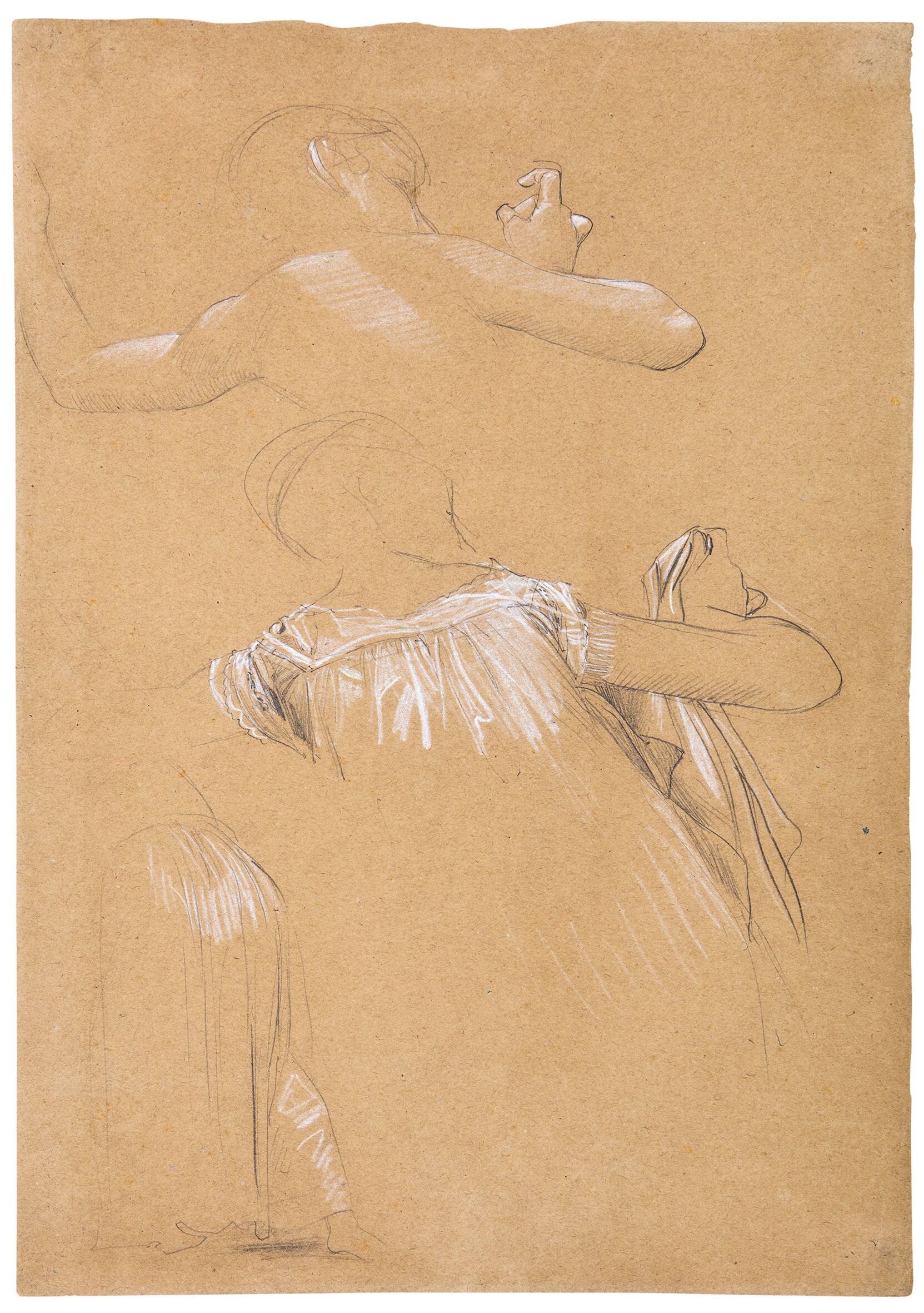
In den Hintergrund tanzendes Mädchen für das Deckenbild "Der Tanz"
Gustav Klimt
1885
ehemalige:r Besitzer:in1918 Nachlass Gustav Klimt (Wien 1918)ehemalige:r Besitzer:invermutlich: 1918-1950 Johanna Zimpel (Wien 1873 - 1950 Wien)ehemalige:r Besitzer:in(vermutlich 1950) Rudolf Zimpel (Wien 1898 - 1984 Mödling)ehemalige:r Besitzer:in Christian M. Nebehay (Leipzig 1909 - 2003 Wien)ehemalige:r Besitzer:in Besitzer:in unbekannt ehemalige:r Besitzer:in2018-2020 Kunsthandel Wienerroither & Kohlbacher (gegründet 1993 in Wien)Besitzer:inab 2020 Privatsammlung , Österreich
Katalogtext
The drawings of this group afford an insight into various aspects of Klimt’s thorough training, as a painter of large decorative schemes, at the Viennese School of Applied Arts (Kunstgewerbeschule), and of the work of his first years as an independent artist. The wide technical and stylistic range that he would have been expected to master in the Vienna of the 1870s and 1880s, the Era of Historicism, was to prove invaluable to his subsequent development as a draughtsman. The designs for ornamental borders, drawn in pen and ink with wash, and notable for their chiaroscuro effects, reveal the influence of the art of the German Renaissance [Strobl 43, 44]. This is evident in the preparatory sketches for ornamental borders for the figural allegories of the Times of the Day [Strobl 41]. The design for an allegory of Opera, by contrast [Strobl 69], is redolent of the style of the High Renaissance in Italy. Both the Times of the Day and the more pictorially executed Opera were among the works assembled for reproduction in Martin Gerlach’s Allegorien und Embleme [Allegories and Emblems], a sumptuous publication to which numerous Austrian and German artists contributed. The lively infants who feature in the architectural framing in these sheets, shown playing musical instruments or clambering over each other, are derived from Klimt’s intensive studies from life (for which real children appear to have posed) and testify to his superb talent for observation.
The ceiling painting for the theatre in Karlsbad (now Karlovy Vary, Czech Republic) and the painted decoration of the interior of the Viennese Hermesvilla (built for the Austrian Empress Elisabeth) were commissioned from the autonomous Maler-Compagnie [Painters’ Company] that Klimt had formed with his colleague Franz Matsch and his own younger brother, Ernst Klimt. Gustav Klimt’s studies relating to diverse figures found in these decorative schemes [Strobl 138, 141, 140] – be it in their confident drawing of outlines or their extraordinarily subtle use of white chalk heightening – already bear witness to his own, highly distinctive style. The trio was to achieve its greatest success with its scheme of painted decoration for the two grand staircases at the Viennese Burgtheater (1886–88). Gustav Klimt also designed the ornamental border (to be executed in watercolour) of the public eulogy addressed and presented, in 1889, to the architect of the Burgtheater, Karl Hasenauer, by those engaged in this outstanding architectural decorative collaboration. In a tracing of figures for this work [Strobl 228], Klimt can be found experimenting with various poses for the principal female figure.
Translation: Elizabeth Clegg, London
Informationen zu diesem Werk können sich aufgrund laufender Forschungsarbeiten ändern.
Information about this work may change as the result of ongoing research.