
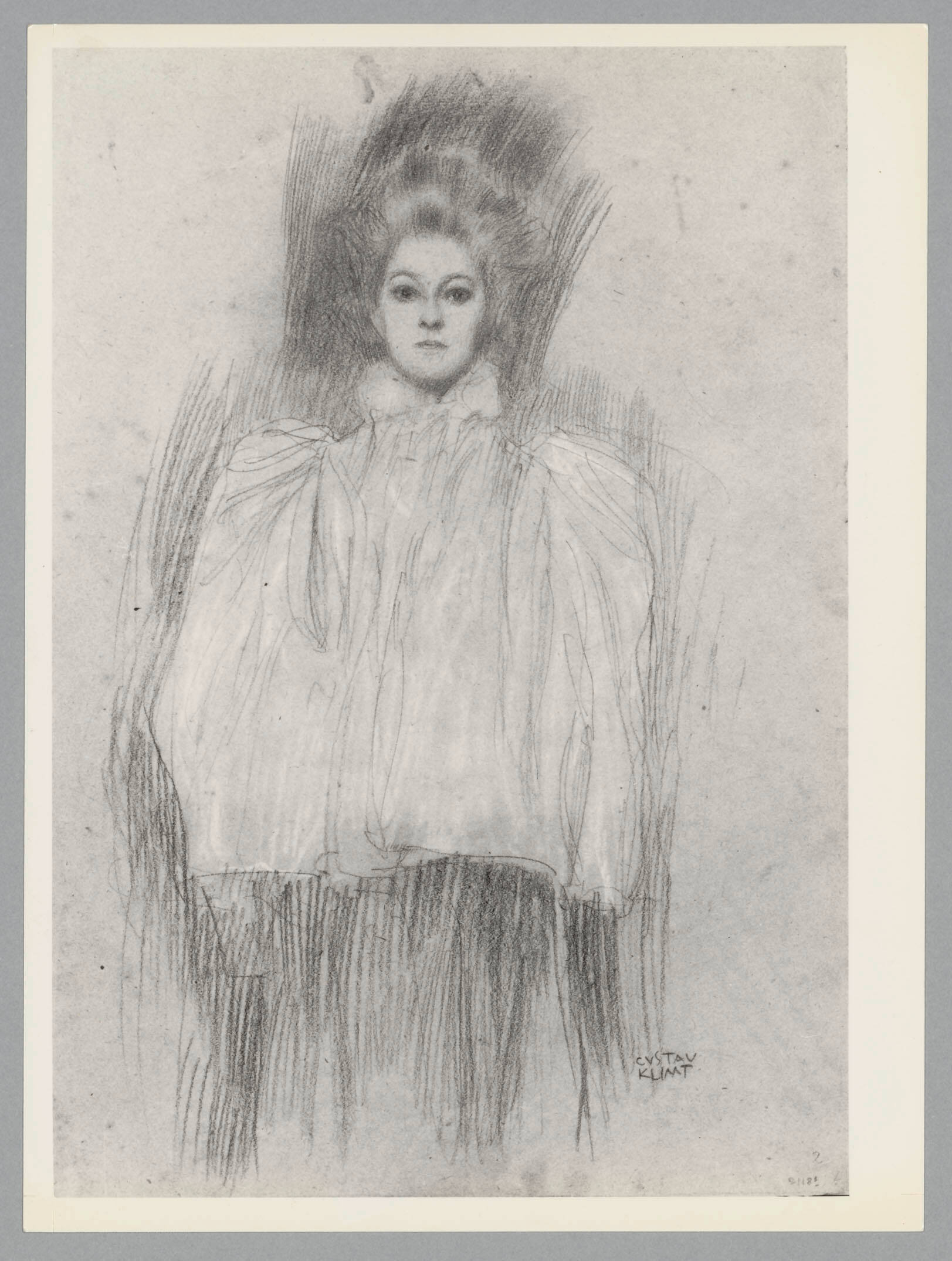
Stehende Dame mit Cape von vorne
Gustav Klimt
um 1887
Datierung laut Manu von Miller 2007 (siehe Vermerke).Exhibitions
ehemalige:r Besitzer:in August Lederer (Böhmisch-Leipa 1857 - 1936 Wien)ehemalige:r Besitzer:in Erich Lederer (Wien 1896 - 1985 Genf)ehemalige:r Besitzer:in Elisabeth Lederer (Wien 1908 - 1995 Genf)ehemalige:r Besitzer:in De Pury & Luxembourg Art (Zürich, 1997 - 2009)Besitzer:in Privatsammlung , New York
Katalogtext
Reproduziert in Ver Sacrum 1898, Märzheft (Abb. 10).
Dieses Blatt wurde in der Literatur mit den Studien für das Ölgemälde "Zuschauerraum des Theaters im Schloß Esterhazy in Totis" in Zusammenhang gebracht. Wie aus Klimts Lebenslauf hervorgeht, war das Gemälde in unvollendetem Zustand als es 1893 im Künstlerhaus ausgestellt die silberne Staatsmedaille zuerkannt erhielt. Sowohl der Ausdruck des Gesichts als auch die Zeichentechnik lassen diese Studie etwas später, etwa um 1896 entstanden erscheinen. Vgl. die Ähnlichkeit mit Kat. Nr. 285. Die Zeichnung könnte auch als Studie für ein in Ver Sacrum 1897 datiertes Damenbildnis (Novotny-Dobai Nr. 77) geschaffen worden sein.
[...]
Vienna´s city council had commissioned Klimt and Matsch in 1887 to memorialize the auditorium of the old Burgtheater on Michaelerplatz, as the building was slated for demolition. For his painting, Klimt chose a perspective from the stage, creating a perfect encapsulation of a nicht at the theater, the audience filled with the most important figures of the era in Viennese society. He apparantly made preparatory sketches in the theater during actual performances and intermissions.
One of these drawings, Sonja Knips (Standing Woman with Cape, Seen from the Front) is of particular salience with regard to the question of when Klimt first encountered Sonja Knips. There is notable disagreement among scholars as to the date of this drawing. The art historian Max Eisler dates the sketch to 1888 and sees it as a figure study for the interior of the Burgtheater. But in the catalogue of a 1976 exhibition at the Museum Folkwang in Essen, the same drawing is associated with the auditorium of the theater in the Esterházy Palace in Totis, Hungary, and is accordingly dated 1893. Alice Strobl, editor of the catalogue raisonné of Klimt´s drawings, proposes a date around 1896, citing the drawing´s formal technique. Strobl also connects this drawing with an oil portrait of a woman, published in the March 1898 edition of the journal Ver Sacrum - that painting, now thought to be lost, was dated 1897. But - judging from the difference in age and facial physiognomy in the two depictions - it seems obious that the drawing Sonja Knips cannot be a preparatory study for that oil portrait: the drawing shows a young girl, while the painting clearly depicts a middle-aged woman.
As other sketches for the Burgtheater were rendered with a very comparable loose cross-hatching technique, it is not unreasonable to assume that this drawing is likewise a peliminary study for the Burgtheater painting, and may be dated around 1887. A comparison wih the 1898 Portrait of Sonja Knips makes it clear that this sketch depicts the same woman, although at a younger age. The correspondences of physiognomy between the drawing and the painting - and with surviving photoraphs of Knips from the period around 1888 - are unmistakable: the oval face, the almond-shaped eyes, the fine and acurately drawn eyebrows, the thin lips and determined gaze. All of these factors indicate compellingly that the depiction is indeed of Sonja - who at the time of the drawing would have been just fifteen years old.
[...]
Informationen zu diesem Werk können sich aufgrund laufender Forschungsarbeiten ändern.
Information about this work may change as the result of ongoing research.