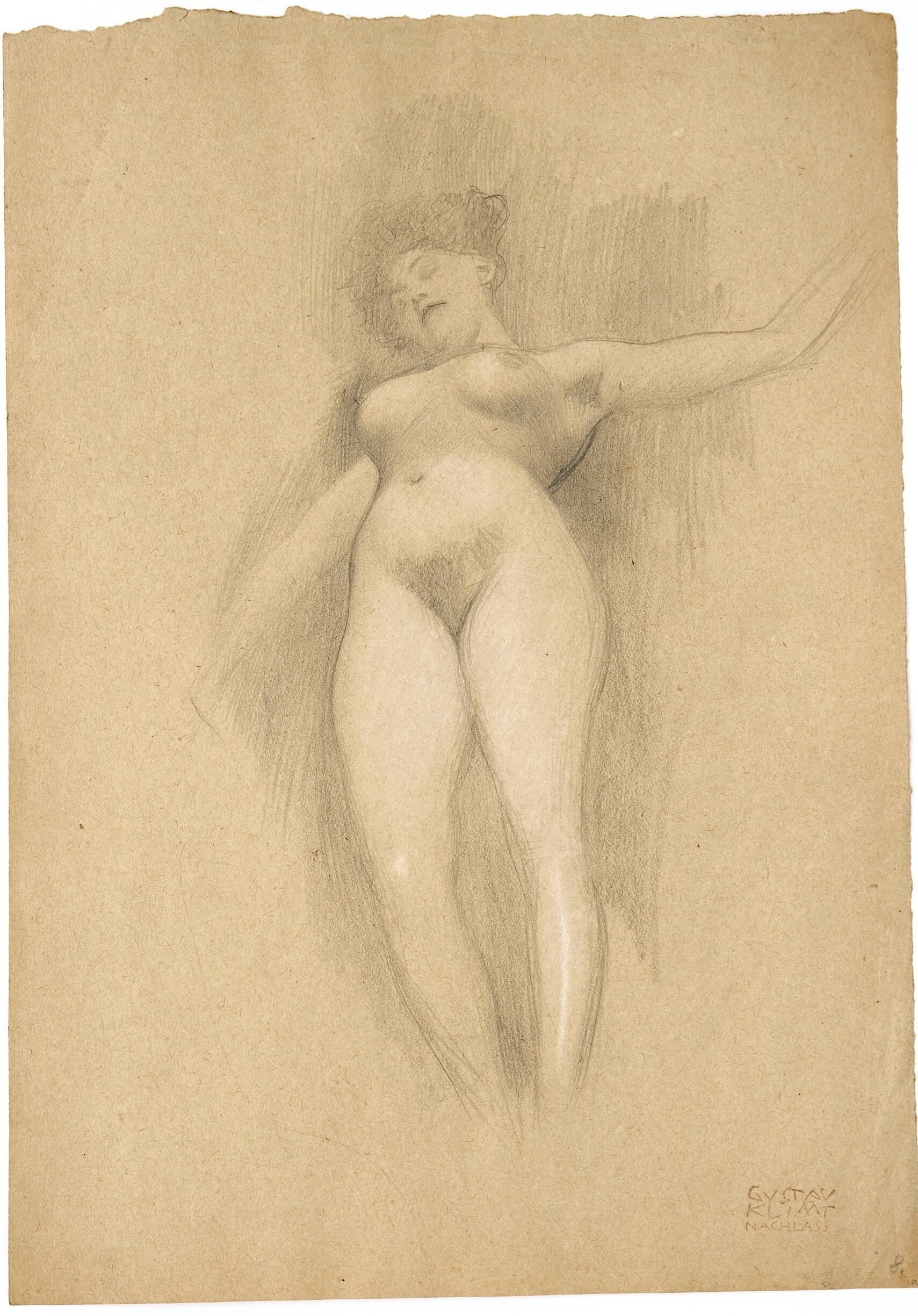
Schwebende vor dunklem Hintergrund
Gustav Klimt
1897/98
Object numberGKZ530
Strobl-Nr.Strobl 530
Künstler:in
Gustav Klimt
(Wien 1862 - 1918 Wien)
Date1897/98
Dimensions45,1 × 32 cm (17 3/4 × 12 5/8 in.)
MediumBleistift, weiß gehöht, auf Papier
Inscribedr.u. "8.", "10."
Markingsr.u. Nachlaßstempel
Curatorial RemarksStudie für das Fakultätsbild MedizinExhibitionsehemalige:r Besitzer:in1918 Nachlass Gustav Klimt (Wien 1918)ehemalige:r Besitzer:in Serge Sabarsky Collection (New York)ehemalige:r Besitzer:inMai 2009 Privatsammlung , USAehemalige:r Besitzer:inOkt. 2009 Galerie St. Etienne (New York)ehemalige:r Besitzer:inbis 2010 Kunsthandel Wienerroither & Kohlbacher (gegründet 1993 in Wien)ehemalige:r Besitzer:inab 2010 Privatsammlung , FrankreichAuktion6.2.2014 London, Sotheby's [132762]ehemalige:r Besitzer:inab 2014 Besitzer:in unbekannt Auktion6.2.2020 Christie's London [76563]Besitzer:in Privatbesitz , New York
Auktionskatalog
London, Sotheby's, 2014:
Condition
Executed on brown wove paper, not laid down, attached to the back board at all four edges, floating in mount. Unevenly cut along top edge. There is a crease at the top left corner and lower left corner below stamp. Sheet appears slightly time stained. Overall good condition.
Christie's London, 2020:
Lot Essay
Lot Essay
In 1894 the Austrian Ministry of Culture and Education commissioned Gustav Klimt and his partner Franz Matsch to paint monumental allegories of the various schools of learning for the Great Hall at the then new University of Vienna. The contract specified that there was to be a large central canvas devoted to Enlightenment with the theme of the triumph of light over darkness and four surrounding paintings depicting Philosophy, Medicine, Jurisprudence and Theology. All five panels were to vindicate and glorify rational science and its usefulness to society. Klimt chose to paint Philosophy, Medicine and Jurisprudence.
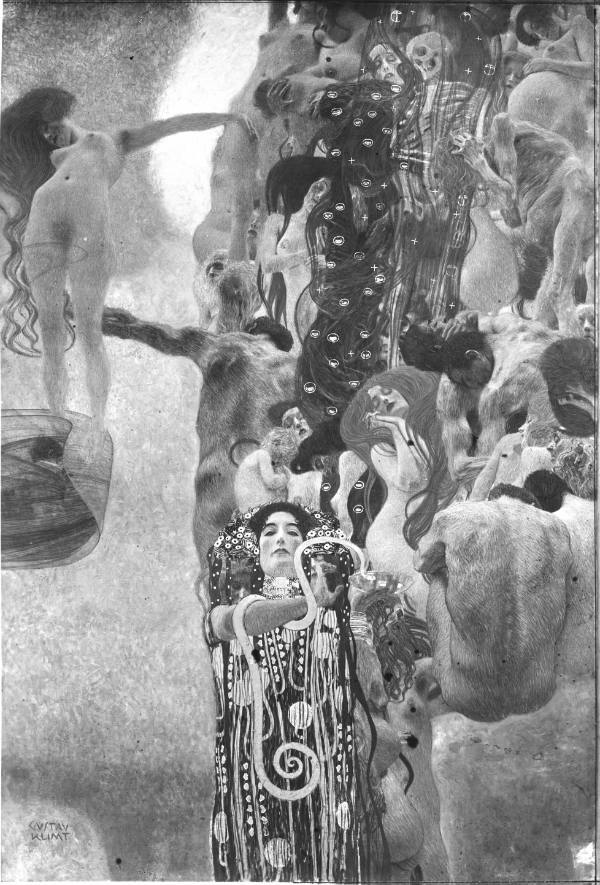
The present work is a study for the female nude floating in space above Hygieia, on the left side of the final painting of Medizin, now destroyed. Within the final composition, the figure portrayed in the present work acted as a symbol of life and health. When Klimt presented his studies for the commission to the Ministry of Education and the University of Vienna on 26 May 1898, they were not well received. Among the critiques, it was reported that one committee member threatened to resign if Klimt did not change the nude female figure to a male youth. Others demanded the figure be clothed, or a certain leg be turned a different way. Discouraged, Klimt wanted to quit, but his friend Baron Weckbecker mediated with the Ministry of Education, which eventually granted him complete artistic freedom.
When the final version of Medizin, completed in 1901, was shown at the Tenth Vienna Secession exhibition from March 15-May 12 1901 the public and especially the medical doctors in attendance were infuriated. The controversy over of the paintings continued and in 1905 the University decided that Klimt’s paintings would not be installed and Klimt secured the return of the works to his studio. Sadly the final version of Medizin, along with the final panels for Philosophy and Jurisprudence, were destroyed in May 1945 when the retreating German SS forces set fire to Schloss Immendorf, a castle in Lower Austria, where they had been storing them after confiscating them from their owners. Only the studies remain, including the present lot and a study in oil – likely the first oil study for Medizin – belonging to the Israel Museum of Art in Jerusalem.
Last edited03.05.2026
Informationen zu diesem Werk können sich aufgrund laufender Forschungsarbeiten ändern.
Information about this work may change as the result of ongoing research.
Informationen zu diesem Werk können sich aufgrund laufender Forschungsarbeiten ändern.
Information about this work may change as the result of ongoing research.