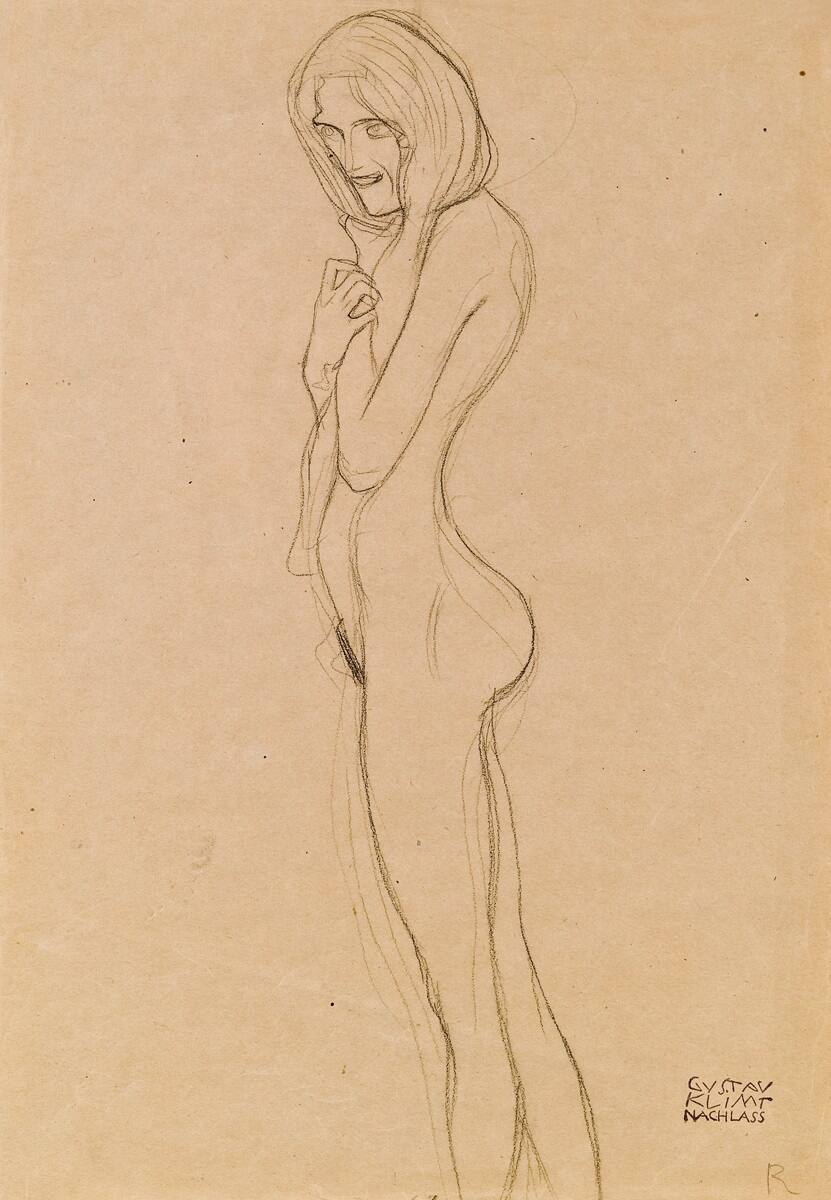
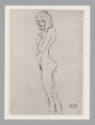
Studie für die linke Figur der "Drei Gorgonen" im Beethovenfries
Gustav Klimt
1901
- Stehender Mädchenakt im Dreiviertelprofil nach links
ehemalige:r Besitzer:in Carl Reininghaus (Graz 1857 - 1929 Wien)ehemalige:r Besitzer:in Erich Lederer (Wien 1896 - 1985 Genf)ehemalige:r Besitzer:inab 1981 Privatbesitz Auktion17.6.2008 Auktionshaus im Kinsky [nicht verkauft](Wien)Besitzer:in2008 Galerie Kovacek Spiegelgasse ehemalige:r Besitzer:inbis 2016 Kunsthandel Wienerroither & Kohlbacher (gegründet 1993 in Wien)Besitzer:inab 2016 Privatsammlung , USA
Bildtext
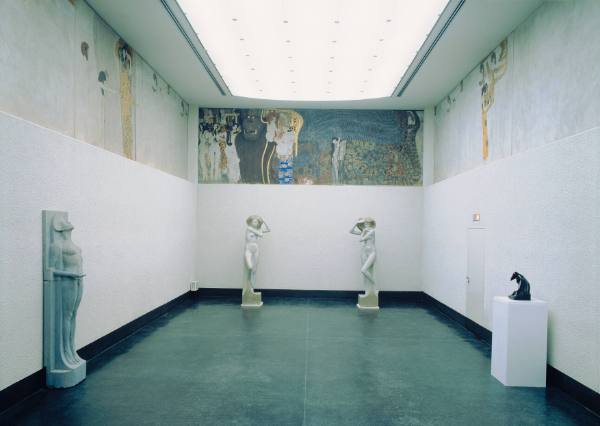
Three sheets [Strobl 786-GKZ786, Strobl 815-GKZ815, Strobl 830-GKZ830] are of particular importance within the present selection. These all belong to the extensive series (now distributed between collections across the globe) of Gustav Klimt’s preparatory studies for his Beethoven Frieze. This outstanding figural cycle was created in the context of the Vienna Secession’s Beethoven Exhibition, which opened in April 1902, and at which a group of 21 artists strove to realize – albeit only temporarily – their ideal of a modern “temple art”. The tripartite interior of this “sacred space”, designed by Josef Hoffmann, was of an emphatic simplicity. Its design, wall decoration, and ornamental elements served to direct attention to the “cult object” in the principal hall: the freshly completed monumental figure of Beethoven by the Leipzig sculptor, painter and print-maker Max Klinger. Many saw this figure, enthroned on clouds, as the quintessence of the artist as genius, struggling and suffering for humanity. In accord with this symbolism, the “temple decorations” contrived by the artists of the Secession were themselves conceived in the spirit of struggle and triumph, of desire and redemption. Through the colourful diversity of materials used in his figure of Beethoven, Klinger also inspired his Viennese colleagues to undertake numerous experiments with new materials and techniques.
As the most celebrated artist of the Secession, Gustav Klimt was to occupy a prominent position within this solemnly festive ensemble, working in an unorthodox combination of casein paint, decorative elements, and stucco mouldings. During the summer of 1901 he set out to paint, on the two long walls and one of the short walls of the left-hand side room, a large-scale allegory of the human desire for happiness (1). According to the description supplied in the exhibition catalogue, the figures of desire seen floating along the top of the painted walls soar beyond the Hostile Powers and will be “assuaged” through Poetry. Humanity achieves its greatest happiness in the fusion of art and love: in the “ideal realm”, towards which “the arts” lead us, an enamoured couple is seen embracing, surrounded by a choir of angels. With reference to this last scene, two quotations from Friedrich Schiller allude to the final chorus of Beethoven’s Ninth Symphony; “Freude, schöner Götterfunken” [Joy, beautiful spark of divinity] and “diesen Kuss der ganzen Welt” [this kiss for the entire world]. The overall concept of the Beethoven Frieze evinces unmistakable analogies with Richard Wagner’s “programmatic commentary” on the Ninth Symphony: a musical creation that, by around 1900, was providing inspiration for many pseudo-religious utopias (2).
For Klimt, his work on the plastered surfaces of Hoffmann’s extremely modern interior was an altogether independent exercise, in the course of which he was able to develop his composition without constraints. He experimented with a dazzling diversity of abstract-geometrical ornaments, in which gold played a great part; and, to complement the planarity of the painting, Klimt opted for a radically new use of line. These crucial stylistic shifts occurred both in his painting and in his work as a draughtsman. In his preparatory figure studies Klimt already incorporates the principle of his adherence to Hoffmann’s purist architecture through subordinating the movements and gestures of his models to strict geometric laws. He emphasises frontal and profile poses and eschews the use of shading to model surfaces. By means of emphatically stylising contours, he brings out the always specific character of his figures.
The first two of our three drawings for the Beethoven Frieze were made in connection with figures to be found on the short wall that links the two longer ones: the Hostile Powers, embodying a highly decorative denunciation of sensual and material pleasure. It was above all the Three Gorgons – convivial companions of the monster Typhoeus – that were found to be especially shocking. The numerous studies for these provocative female figures are distinguished through their sensually curved contours and their loosely falling, buoyantly stylised hair. The present drawing [Strobl 786-GKZ786], a relatively close approximation to the left-hand Gorgon, strikes us as the quintessence of the femme fatale. Her clenched fingers, mouth convulsed with carnal desire, and eyes wide open like those of a mad woman all hint at daemonic possession. Klimt wields his black chalk with particular sensitivity. In combination with packing paper, cut into sheets always equal in size, this was to remain his chief drawing medium until 1903/04.
Almost all the models for figures in the Beethoven Frieze whom Klimt shows standing are cropped just above the feet by the lower edge of the sheet. Our figure, too, appears to have been lifted off the earth by this intervention. At one and the same time she remains in an indeterminate void and yet is also unshakably anchored to the drawing surface. Here, a strict monumentality is counterbalanced by the sensual melody of line. Ambivalence of this sort was to characterise Klimt’s figure drawings throughout his career.
(1) According to the most recent findings, Klimt had already completed the painting of his Beethoven Frieze during the summer of 1901, which would indicate that the studies long dated to 1901/02 should in fact be dated to 1901. See: Hansjörg Krug, “Gustav Klimt selbstredend”, in: Tobias Natter, ed., Gustav Klimt: Sämtliche Gemälde, Cologne 2012, p. 488, undated letter (August 1901) no. 80 to Marie Zimmermann. As reported by contemporary critics, even shortly before the repeatedly postponed exhibition opening, Klimt was still to be observed at work on the scaffold erected to give access to the Frieze.
(2) The connection with Richard Wagner’s programmatic elucidation of Beethoven’s Ninth Symphony was first noted in Marian Bisanz-Prakken, Gustav Klimt. Der Beethovenfries. Geschichte, Funktion und Bedeutung, Salzburg 1977, pp. 32-34.
Translation: Elizabeth Clegg, London
Informationen zu diesem Werk können sich aufgrund laufender Forschungsarbeiten ändern.
Information about this work may change as the result of ongoing research.