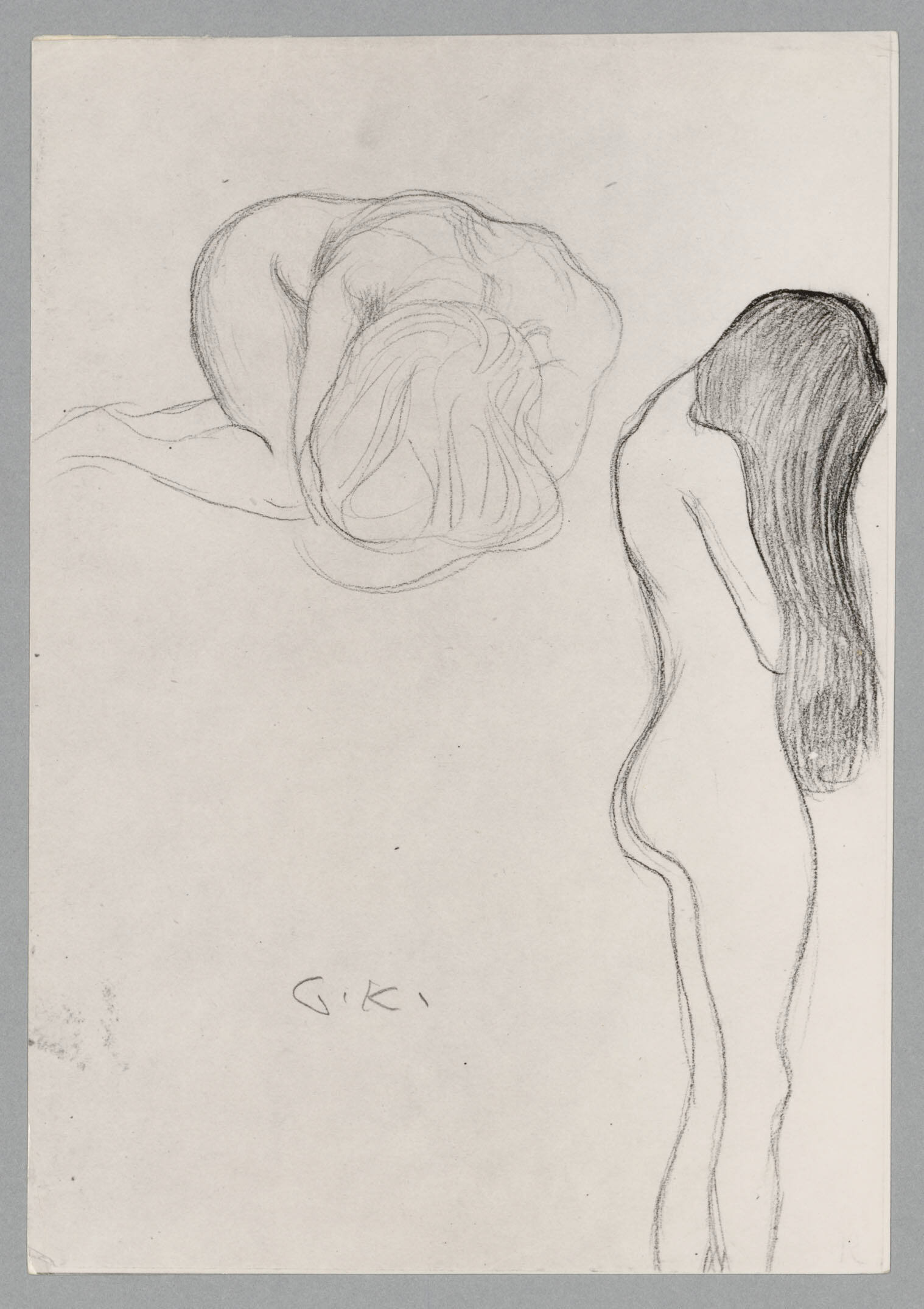
Zusammengekauerter und nach rechts stehender Frauenakt
Gustav Klimt
1901
ehemalige:r Besitzer:in Carl Reininghaus (Graz 1857 - 1929 Wien)ehemalige:r Besitzer:in August Lederer (Böhmisch-Leipa 1857 - 1936 Wien)ehemalige:r Besitzer:in Erich Lederer (Wien 1896 - 1985 Genf)ehemalige:r Besitzer:inab 1973 Piccadilly Gallery (London, 1953 - 2007)ehemalige:r Besitzer:in1873-2022 Besitzer:in unbekannt Auktion6.7.2022 London, Sotheby's [79323]ehemalige:r Besitzer:in Privatsammlung Besitzer:in2024 Stephen Ongpin Fine Art (London)
Werkverzeichnis
Gustav Klimt was one of the foremost draughtsmen of the early 20th century, and while over four thousand drawings by him are known today, many more have been lost.[1] As the Klimt scholar Marian Bisanz-Prakken has written, ´His intensive study of the human – primarily the female – figure centred on the individual…Klimt drew obsessively, subjecting himself to a highly disciplined approach. He usually worked from life, whereby he would subordinate the models´ poses and gestures to an overarching design…As a creative draughtsman, Klimt was a law unto himself; as a result, the body of his works on paper is so rich and vomprehensive that it must be viewed as a parallel universe, existing alongside his painterly oeuvre.´[2] Another art historian has aptly described Klimt as having ´an obsessive erotic engagement with the female form´.[3] Several contemporary accounts of the painter´s studio in Vienna record the constant presence of female models. One writer, perhaps only slightly fancifully, noted that ´Here he was, surrounded by enigmatic naked women who, as he stood silently before his easel, would stroll up and down in his workshop, stretch and laze about, casting their radiance on the daylight hours – ever ready to obediently hold a pose at a nod from the master, as soon as he espied some posture, some movement that appealed to his aesthetic sense which he wanted to record in a quick sketch.´[4]
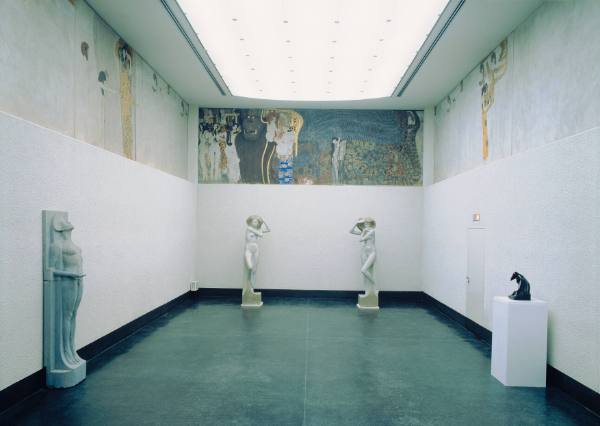
This large sheet is part of a group of figure drawings that can be associated with one of Klimt´s most significant public works; the monumental Beethoven Frieze fresco of 1901-1902, designed for the Secession Building in Vienna on the occasion of the 14th Secession Exhibition of 1902. The Secession exhibition that year was unusual in that it was devoted to the presentation of a single work; a large sculpture of Beethoven by the German artist Max Klinger. Flanking the gallery that housed this sculpture were two side rooms, and it was the frieze decoration of one of these rooms that was entrusted to Klimt. Originally intended as a temporary decorative scheme, to be destroyed after the Secession Exhibition, Klimt´s Beethoven Frieze was instead acquired by the Austrian industrialist Carl Reininghaus, and by 1915 had passed to the Viennese collector August Lederer. The entire ensemble, divided into eight panels, is today in the collection of the Österreichische Galerie and on permanent display in the Secession Building.[5]
As Tobias Natter has noted of the Beethoven Frieze project, ´The development of the concept of the Gesamtkunstwerk – or total work of art – and its realization in a number of exhibitions and architectural schemes can possibly be considered the most significant achievement of the artistic revolution in Vienna around 1900…The pinnacle of the purposeful integration of all arts was the fourteenth Secession exhibition from April to June 1902, the ´Beethoven Exhibition´…In the Beethoven exhibition, architecture, painting and sculpture came together in a coherent whole around the celebration of the life and music of the composer Ludwig van Beethoven and his Ninth Symphony in particular. Klimt´s magnificent Beethoven Frieze, the artist´s largest surviving integrated scheme, was intended a sort of the Secession´s homage to the compser…The Secession deliberately set out to realize an ambitious scheme that fully utilized paining and sculpture in a carefully designed interior space devoted to the worship of the artistic genius of Beethoven.´[6]
Klimt´s Beethoven Frieze was situated in one of the two wings of the Secession building, placed within a staging designed by the architect Josef Hoffmann, and was comprised of two long side walls and a short end wall. Running along the top of all three walls, the frieze measures just over two metres in height and is some thirty-four metres long. The elaborate allegorical narrative of the frieze, intended to be read from left to right, depicted a series of figures representing ´humanity´s journey and struggle in communal joy…Klimt´s Frieze represents an idiosyncratic homage to Beethoven´s Ninth Symphony in which the artist interprets a musical piece through a highly inventive and imaginative visual narrative.´[7]
As Rainer Metzger has written of Klimt´s preparatory process for the project, ´a large number of studio sketches were produces that explored the individual figures and groups of the Beethoven Frieze, the male and the female, the young and the old. Klimt applied the casein paint directly to the plaster on the basis of this collection of materials. The drawings were put on paper in full knowledge of their subsequent use, many oft hem including poses that can be found on the wall. The figures are often shown as very compact silhouettes or clearly outlines shapes, in the same way that they appear on the large surface of the frieze. These preliminary drawings had a very specific purpose, and the fact that they were to be included in a frieze was already implicit in their form. This gives them a concision and self-containedness that other drawings lack.´[8]
In her catalogue raisonné of Klimt´s drawings, Alice Strobl suggested that the present sheet contains the artist´s first ideas for the nude figure of ´Gnawing Sorrow` (`Nagender Kummer`)[9] in the Beethoven Frieze. Neither figure was used in the final work, however, although the standing figure may have been referred to a year or so later, when Klimt was developing the poses of the criminals in the Jurisprudence painted for the ceiling oft he great hall oft he University of Vienna between 1903 and 1907[10].
The first owner of this drawing was the Viennese industrialist and art collector August Lederer (1857-1936). The second wealthiest family in Vienna, after the Rothschilds, the Lederers assembled a superb art collection, mostly devoted to artists of the Vienna Secession. August Lederer, his wife Serena and eldest son Erich were the most important patrons and collectors of the work of Gustav Klimt, by whom they owned some twenty paintings, including the Beethoven Frieze fresco itself, as well as numerous drawings, although much of their collection of paintings was lost during the Second Word War. As Christian Nebehay has stated, ´Special mention must be made of the Klimt drawings in the Lederer Collection, which fortunately survived the chaos oft he war years. One could justly claim that this collection is, for sheer quality, the finest known. We find here, selected by a discriminating taste, a large number of Klimt´s notable drawings.´[11]
[1] The artist is known to have often thrown away his drawings, while some fifty sketchbooks were destroyed in a fire in 1945. That Klimt did not regard his drawings too highly is seen in an anecdote recounted by the Austrian art critic Arthur Rössler: ´Klimt valued this abundant evidence of his industrious and penetrating study of nature only as means to an end, and he destroyed thousands of leaves when they had fulfilled their purpose, or if they failed to combine maximum expressiveness with the appilcation of a minimum of technique. On one occasion when I was sitting with Klimt, leafing through a heap of five hundred or so [drawings], surrounded by eight or nine cats meowing or purring, which chased each other around so the rustling leaves flew through the air, I asked him in astonishment why he let them carry on like that, spoiling hundreds of the best drawings. Klimt answered, “No matter if they crumple or tear a few of the leaves – they piss on the others and that´s the best fixative!“´; Arthur Rössler, In memoriam Gustav Klimt, Vienna, 1926; Quoted in translation in Susanna Partsch, Klimt: Life and Work, Munich, 1993, p.297.
[2] Marian Bisanz-Prakken, ´The drawings: a cosmos unto themselves. Stnaces – moods`, in Tobias G. Natter, ed., Gustav Klimt: The Complete Paintings, Cologne, 2012, p.373.
[3] Colin B. Bailey, `Prolegomena: A Klimt for the Twenty-first Century`, in Colin B. Bailey, ed., Gustav Klimt: Modernism in the Making, exhibition catalogue, Ottawa, National Gallery of Canada, 2001, p.15.
[4] Quoted in translation in Marian Bisanz-Prakken, `Gustav Klimt´s Drawings`, in Bailey, ed., ibid., p.143.
[5] Fritz Novotny and Johannes Dobai, Gustav Klimt, with a Catalogue Raisonné of His Paintings, London, 1968 [1975 ed.], pp.326-329, no.127, pls.37-41; Fritz Novotny and Johannes Dobai, Gustav Klimt, Salzburg, 1975, pp.325-328, no.127; Tobias G. Natter, ed., Gustav Klimt: Drawings and Paintings, Cologne, 2018, pp.114-117 and 119-125.
[6] Natter, ibid., pp.88-90.
[7] Natter, op.cit., pp.90 and 93.
[8] Rainer Metzger, Gustav Klimt: Drawings and Watercolors, London, 2005, p.121.
[9] Novotny and Dobai, op.cit., pl.39; also illustrated p.327, under no.127; Natter, ed., op.cit., 2018, illustrated pp. 121-122.
[10] Natter, ed., op.cit., 2018, illustrated p.130. Klimt´s ceiling paintings for the University were destroyed by fire during the Second World War.
[11] Christian Nebehay, Gustav Klimt Dokumentation, Vienna, 1969, p.192; Quoted in translation in Johannes Dobai, `Introduction`, in London, Piccadilly Gallery, op.cit., unpaginated.
Informationen zu diesem Werk können sich aufgrund laufender Forschungsarbeiten ändern.
Information about this work may change as the result of ongoing research.