
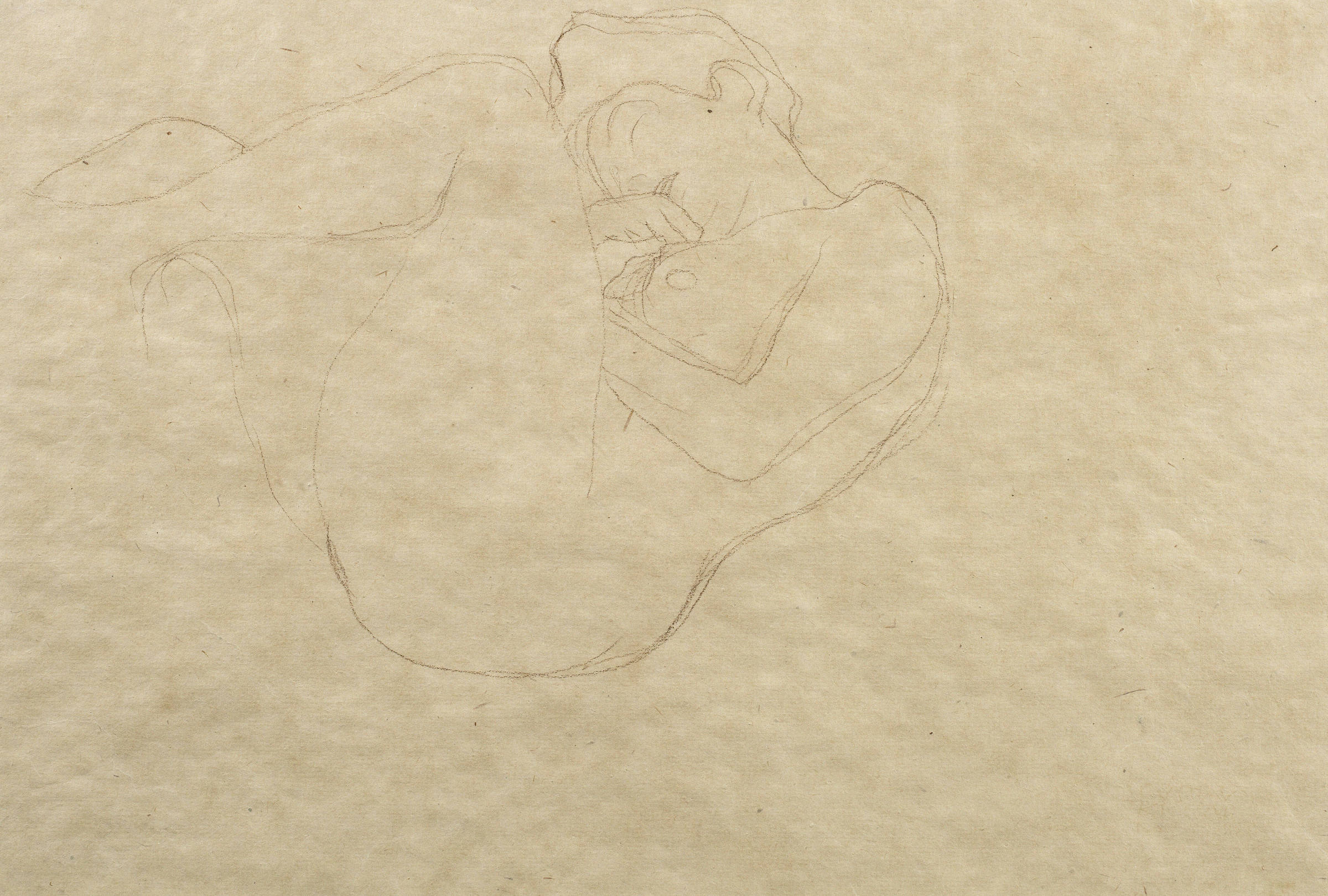


Zurückgelehnt liegender Frauenakt nach links
Gustav Klimt
1903
ehemalige:r Besitzer:in Rudolf Staechelin (Basel 1881 - 1946 Basel)ehemalige:r Besitzer:in Galerie Würthle (Wien)ehemalige:r Besitzer:inca. 1975-1980 Privatsammlung , UKAuktion23.6.2016 Bonhams [nicht verkauft](London)Auktion22.6.2017 Bonhams [59025](London)ehemalige:r Besitzer:in2017-2019 Besitzer:in unbekannt Auktion27.2.2019 London, Sotheby's [35096]Besitzer:in Besitzer:in unbekannt
Werkverzeichnis
The present work is the most direct known study for Gustav Klimt's 1907 seminal work Danaë. Here, unlike in other sketches for the painting, the model is presented in almost exactly the same pose – head and arms tightly tucked into the chest with a monumental thigh raised dramatically to provide a seductive focal point for the later composition.
Danaë was the last subject that Klimt would draw from Greek mythology. In the finished painting he depicts the moment of her impregnation by Zeus, represented by a shower of golden rain that falls from above to between the figure's legs. According to the myth, the King of the gods took pity on the princess after her father, the King of Argos, had decided to imprison her upon hearing a prophecy that his death would be at the hands of his future grandson. While Danaë was a popular subject during the early 1900s as a symbol of divine love and transcendence, Klimt infused his eponymous painting with a palpable, almost shocking sexuality. Representing women within a literary context allowed Klimt to express the themes of eroticism and desire in a manner acceptable to the Viennese bourgeoisie although, like the midnight-blue sheer robe that barely covers the figure, Danaë's visceral sensuality is thinly-veiled.
As with the painting, in the present work Klimt employs delicate meandering lines to tenderly depict the form of his slumbering model. In Zurückgelehnt liegender Frauenakt nach links however, the sexual charge is muted, rather revealing the transience of the moment as the artist sketched his model within the atelier. The hand is closed to support the head rather than clenched, and the model's expression appears relaxed and vacant as if she is fast asleep. In the economy and fluidity of line so synonymous with the hand of Klimt, this work remains an essential study for one of the most important oils within his oeuvre, as well as offering a tantalising insight into the closely guarded interior of the artist's studio where Klimt, 'surrounded by mysteriously naked females...stood silently at his easel [as] they wandered to and fro...obediently halting in their tracks as soon as the artist espied a pose or a movement that his sense of beauty impelled him to capture in a swiftly executed sketch' (an observation by the journalist Franz Servaes in 1908, quoted in A. Weidinger, (ed.), Gustav Klimt, Munich, 2007, p. 191).
Condition
Executed on cream wove paper, not laid down and hinged to its mount. The sheet is lightly time-stained with further mount stained marks to the extreme edges, which are not visible when framed. There are some minor flecks of brown visible to the figure's body, which are inherent in the medium. There are some minor spots of foxing, predominantly to the background of the sheet. This work is in overall good condition.
Catalogue Note
The present work is one of the most closely related studies for Gustav Klimt’s painting, Danaë, a seminal work for the artist which was executed in 1907 (fig. 1). Displaying Klimt’s mastery of rendering interesting poses, this intimate drawing of 1903 reflects the same pose as Danaë, unlike his other sketches for the painting. The woman has her head and arms tightly tucked into her chest and her thigh is raised high, providing a seductive focal point for the viewer. Klimt employs delicate meandering lines to tenderly depict the form of his slumbering model. The figure of Danaë was the last subject that Klimt would draw from Greek mythology. In the painting, it depicts the moment of Danaë’s impregnation by Zeus, represented by a shower of golden rain that falls from above to between the figure’s legs. According to the myth, the King of the Gods took pity on the princess after her father, the King of Argos, had decided to intern his daughter upon hearing a prophecy that his death would be at the hands of a grandson. Presenting the model unabashedly naked, Klimt infuses the painting with a tangible, almost shocking sensuality. While Danaë was a popular subject during the early 1900s as a symbol for divine love and transcendence, Klimt exploited the opportunity of representing a literary character by pushing the boundaries of sexual representation, while seemingly retaining its acceptability for the Viennese bourgeoisie. In his painting, the undulating contours of her body serve to emphasise the sensual lines of her buttock, thigh and breast, while the clenched hand belies her apparent repose and reveals a moment of arousal, heightened by her slightly parted lips.
In Zurückgelehnt liegender Frauenakt nach links, the sexual charge is more muted and it instead reveals the momentary transience of the woman’s slumbered state. The hand is closed, rather than clenched and the model’s expression appears relaxed as if she is falling asleep. This work remains an essential study for one of the most important oils within Klimt’s oeuvre; it heralds the artist’s command over the fluidity of line and offers a tantalising insight into the interior of his studio.
Informationen zu diesem Werk können sich aufgrund laufender Forschungsarbeiten ändern.
Information about this work may change as the result of ongoing research.