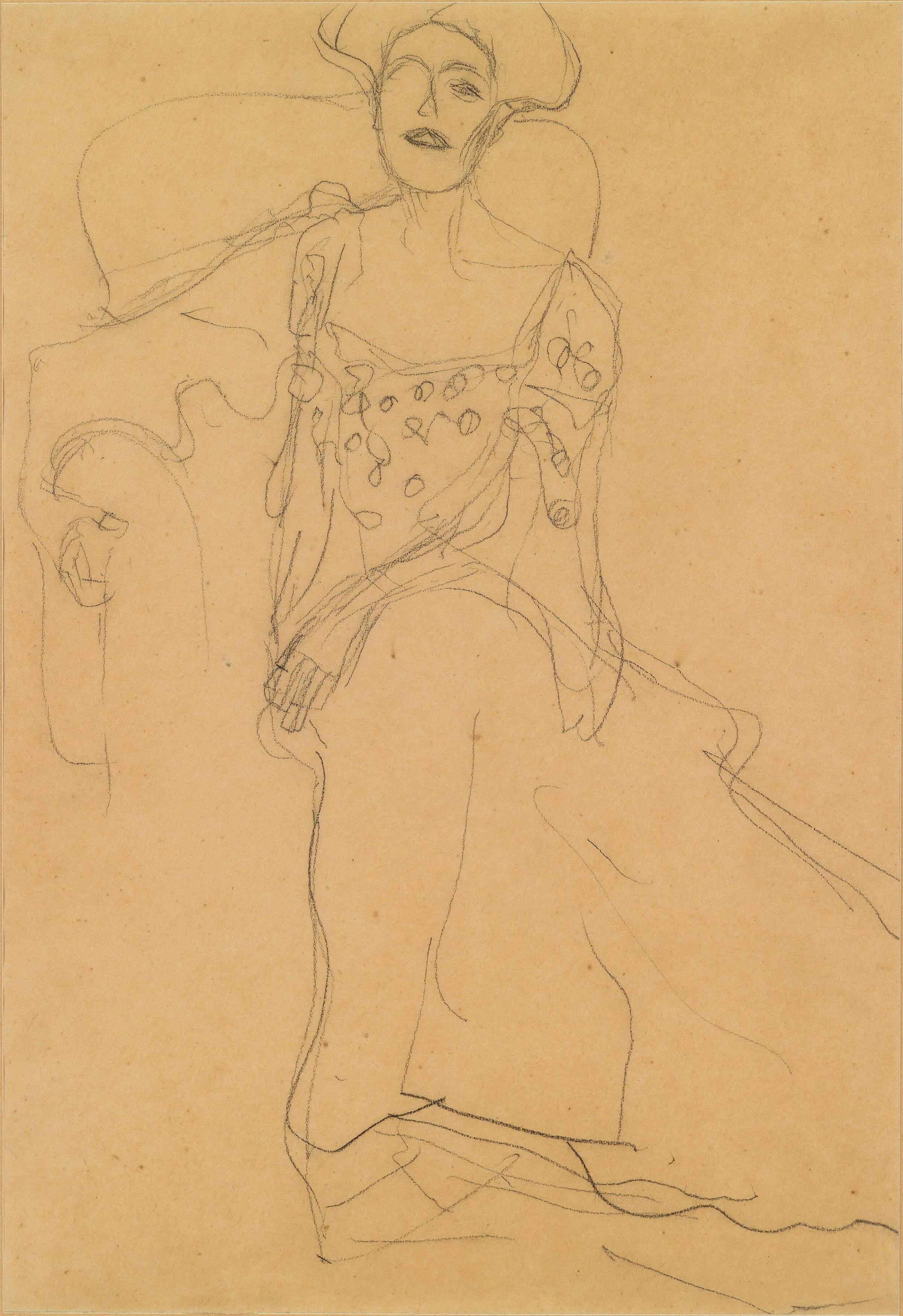
Studie zu Bildnis Adele Bloch-Bauer: Sitzend von vorne, den rechten Arm um die Lehne des Stuhles gelegt
Gustav Klimt
1903
ehemalige:r Besitzer:in Galerie Welz (Salzburg)Auktion19.6.1970 Klipstein & Kornfeld (Bern, gegründet 1956)ehemalige:r Besitzer:in Privatbesitz , WienAuktion22.5.2014 Dorotheum Wien [36000]ehemalige:r Besitzer:in Besitzer:in unbekannt ehemalige:r Besitzer:inbis 2015 Kunsthandel Wienerroither & Kohlbacher (gegründet 1993 in Wien)Besitzer:inab 2015 Privatsammlung , USA
Werkverzeichnis
Alice Strobl, Gustav Klimt, Die Zeichnungen 1878 - 1903, Band I, Verlag Galerie Welz, Salzburg 1980, Nr. 1066, Abb. Seite 307 dort angeführt: Dieses Blatt sowie Kat. Nr. 1068 und 1069 zeigen ein streublumenartig über das Kleid verteiltes Muster. Die kleinen Ringe sind wohl als Stilisierungsform von Blumen zu verstehen.
Abgebildet in:
Otto Breicha, Gustav Klimt, die goldene Pforte , Werk, Wesen, Wirkung, Bilder und Schriften zum Leben und Werk, 1978, Abb.88
Provenienz:
Ehemals Galerie Welz, Salzburg
Kornfeld und Klipstein, 137. Auktion 17. - 19.6. 1970, Nr. 698 (Tafel 33)
Privatbesitz, Wien
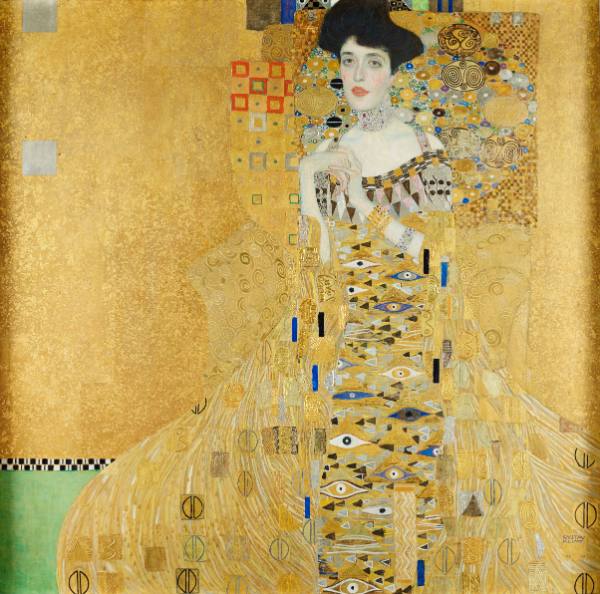
Das Bildnis "Adele Bloch-Bauer I" ("Goldene Adele"), ist im Besitz der Neuen Galerie, New York.
In 1907 Gustav Klimt finished work on a portrait of Adele Bloch-Bauer (1881-1925), daughter of the banker Moriz Bauer and wife of the industrialist Ferdinand Bloch. The square-format painting has come to be viewed as one of the greatest achievements of Klimt’s “golden period” on account of the opulence of its ornamental use of gold. The turbulent history of this now world-famous portrait, a history marked by episodes of expropriation and restitution, entered a new phase in 2006, when the picture was acquired, in spectacular circumstances, by the Neue Galerie New York. No less fascinating are the studies that Klimt made in preparation for the painted portrait, most of them produced in 1903 – quite some time, that is to say, before he completed the painting itself. Of these, around 130 have so far come to light in diverse locations across the globe. While each of these exquisitely subtle works on paper is, in every sense, eclipsed by the completed painting, it is nonetheless true that, on account of the sensitivity of Klimt’s use of line, each of these drawings may truly be acclaimed as a perfectly autonomous work of art. In the presence of the sitter, Klimt as draughtsman, repeatedly set himself the challenge of capturing his model – dressed in a variety of fashionable outfits and adopting a range of elegant poses – in the totality of her appearance and yet perfectly in accord with the two-dimensional form on the sheet in front of him. In sheet after sheet it is clear that he was seeking the perfect synthesis of pose, gesture and the most fitting form of dress. Gustav Klimt was quite evidently fascinated by the very particular sensual allure of this young woman of 22; and it was in response to the inspiration he found in her that he was moved to make an unusually large number of the enchanting preparatory studies that are now regarded as among the highpoints of his work as a draughtsman. Each of the three studies discussed in the following text throws a different light on the intensity of Klimt’s approach to drawing from the model. Earlier research suggests that the drawing in which Adele Bloch-Bauer, seated in an armchair, is viewed frontally [Strobl 1066-GKZ1066] is among the earliest in the series. By means of some gentler and some more powerfully curving strokes of his chalk, Klimt uses the resulting lines to distinguish clearly between the several components within the drawing. The sitter’s lower left arm rests upon her crossed knee, marking the intersection of the plain triangle of the skirt and densely patterned area of the blouse. The bent right arm with its slightly crippled hand is no more than suggested; the contiguous, entirely vertical contour of the body is, by contrast, set off emphatically against the vacuum of the chair. An unmistakable feature of almost all Klimt’s studies of Adele Bloch-Bauer is the cropping of the face by the upper edge of the sheet – a device inspired by the work of the Belgian Symbolist Fernand Khnopff. This here has the effect of projecting forward into an illusion of proximity the triangular stylisation of the sitter’s mouth. At the same time such exercises in fragmentation – the skirt is itself partially cropped by the right edge of the sheet – effectively erect a barrier between the subject and the observer. All the drawings Klimt made in preparation for his famous portrait are characterised by this mysterious ambivalence between sensual proximity and a majestic distance. Klimt’s deep-rooted tendency to subordinate the poses and gestures of his model to a higher, geometrical order is especially evident in another study of Adele Bloch-Bauer [Strobl 1080-GKZ1080], whom he mostly showed in a seated position. As if he were employing sketchily outlined building blocks, Klimt constructs the “architecture” of the figure, who remains firmly anchored in her chair. As in many of the other drawings of this sitter, the less attentive Klimt is to delineating the eyes, the more impact is imparted to the mouth. As in every study, this characteristically triangular mouth is at first rendered delicately, and is then – with its position slightly shifted – emphatically outlined. The asymmetrical positioning of the sitter in the drawing anticipates her placing within the painting no less than does the angular rendering of the thin arms and the clasped hands. A carefully calculated overlapping of forms establishes a sense of balance imbued with a tension between spaces that are “full” and spaces that are “empty”. It is in the large group of drawings in which Adele Bloch-Bauer is shown seated, wearing a dress of delicate pleated material that falls freely from a narrow band attached to shoulder straps, that Klimt would appear to have fully attained all that he had been striving for in these studies. With the animated jutting of each line he seems to engage in a veritable tight-rope walk between sensitivity and a sublimated power, between sensuality and transcendence. The drawing presented here [GKZ3844], which is not included in Alice Strobl’s catalogue raisonné, is a great rarity in that Klimt supplements and complements the undulating lines drawn in black chalk with corresponding lines drawn in yellow. In combination with the colour of the drawing surface, this generates endless, shimmering nuances, which in turn give rise to an incomparable luminosity. This remarkable combination of black and yellow chalk has so far been discovered in only one other study from this group. As Alice Strobl conjectured, it is possible that Klimt, during this phase of his career, may already have planned to produce a “gold” painting. Klimt did indeed refer to the flowing parallel lines in his studies from the model when he came to work, with gold and silver, on his celebrated painting of Adele Bloch-Bauer. What does not recur in the painting is that blend of sensual immediacy and lyrical buoyancy that we find in the drawn studies.
Translation: Elizabeth Clegg, London
Informationen zu diesem Werk können sich aufgrund laufender Forschungsarbeiten ändern.
Information about this work may change as the result of ongoing research.