
Foto: Kunsthandel Wienerroither & Kohlbacher, Wien
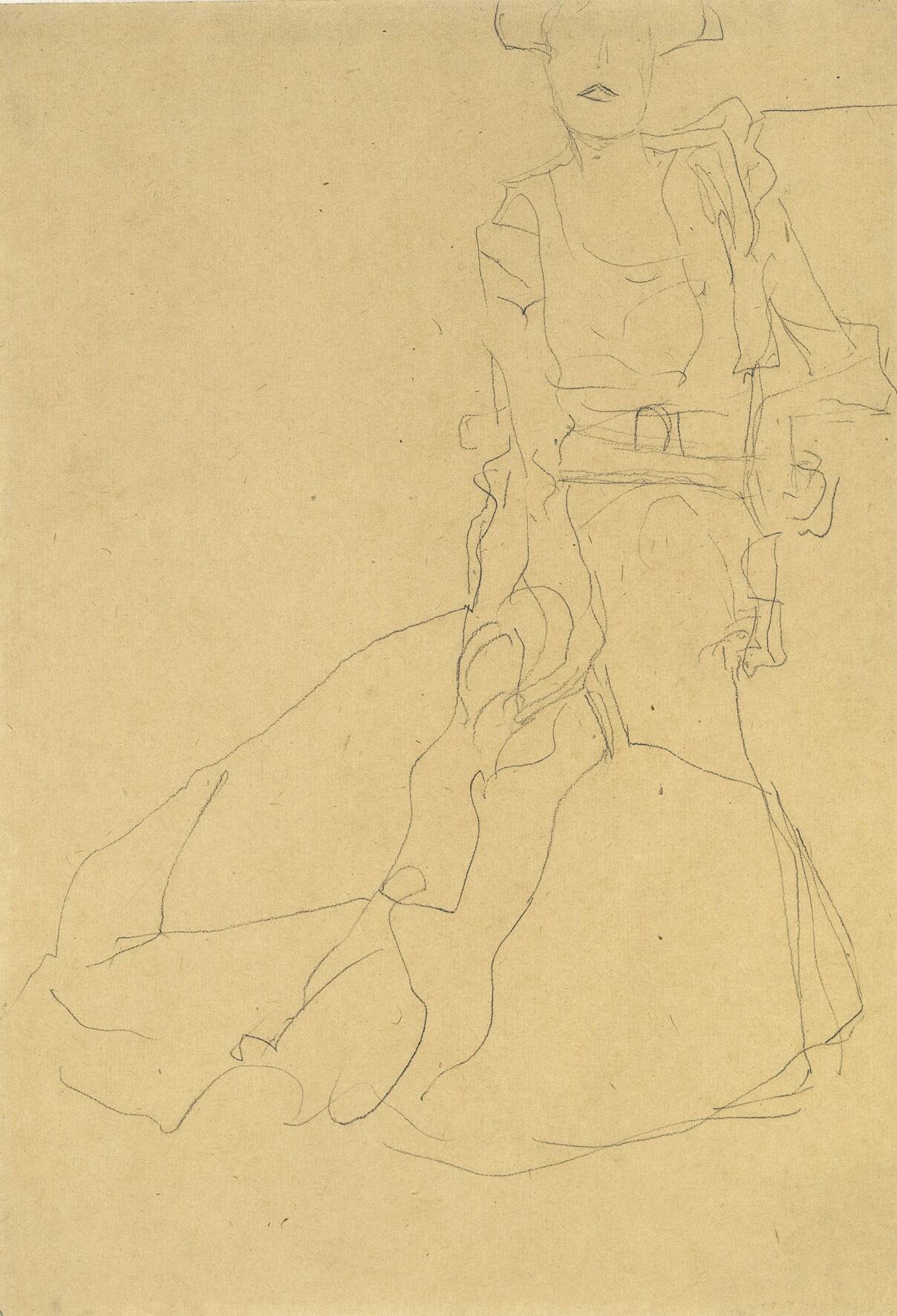
Studie zu Bildnis Adele Bloch-Bauer: Sitzend von vorne
Foto: Kunsthandel Wienerroither & Kohlbacher, Wien

Studie zu Bildnis Adele Bloch-Bauer: Sitzend von vorne

Gustav Klimt

1903


Object numberGKZ1080
Strobl-Nr.Strobl 1080
Künstler:in (Wien 1862 - 1918 Wien)
Dargestellt (Wien 1881 - 1925 Wien)
Date1903
Dimensions46 × 31,5 cm
MediumBleistift auf Papier
Exhibitions
  • 2008 Wien, Kunsthandel Wienerroither & Kohlbacher (15.10.2008 - 15.11.2008)
  • Published References
  • Alice Strobl, Gustav Klimt. Die Zeichnungen 1878–1903, Bd. I, Salzburg 1980, WV-Nr. 1080, S. 308 (Abb. S. 309)
  • Kunsthandel Wienerroither & Kohlbacher, Österreichische Meister der Klassischen Moderne V, Bd. 6, Wien 2002, Nr. 12
  • Rainer Metzger, Gustav Klimt. Das graphische Werk, Wien 2005 (Abb. S. 216)
  • Marian Bisanz-Prakken, Gustav Klimt – Egon Schiele, hg. von Wienerroither & Kohlbacher, Band 13, Wien 2008, Kat. 3
  • Marian Bisanz-Prakken, Gustav Klimt. Drawings/Zeichnungen, hg. von Wienerroither & Kohlbacher, Wien 2012, Kat. 7
  • Marian Bisanz-Prakken, Gustav Klimt. Adele Bloch-Bauer I. Three Drawings, Wien 2015, Kat. 2
  • Provenance
  • Galerie Welz, Salzburg
  • 15.5.2001 Hassfurther, Wien, Los 29 (Abb. S. 55) (nicht verkauft)
  • 27.11.2001 Hassfurther, Wien, Los 111 (Abb. S. 145)
  • Privatsammlung, Österreich [Quelle: Kunsthandel Wienerroither & Kohlbacher, Wien]
  • 2008 Kunsthandel Wienerroither & Kohlbacher, Wien
  • 2015 Privatsammlung, Frankreich (erworben von Kunsthandel Wienerroither & Kohlbacher, Wien) [Quelle: Kunsthandel Wienerroither & Kohlbacher, Wien]

  • ehemalige:r Besitzer:in(Salzburg)Auktion Galerie & Auktionshaus Hassfurther [nicht verkauft](Wien)Auktion Galerie & Auktionshaus Hassfurther [18168](Wien)ehemalige:r Besitzer:in, Österreichehemalige:r Besitzer:in Kunsthandel Wienerroither & Kohlbacher (gegründet 1993 in Wien)Besitzer:in Privatsammlung , Frankreich
    Werkverzeichnis
    Alice Strobl, 1980:
    Auffallend ist das Eckige in der Gestaltung, das besonders auch in der Haltung der Hände und Arme zum Ausdruck kommt.
    Katalogtext
    Marian Bisanz-Prakken, 2015:
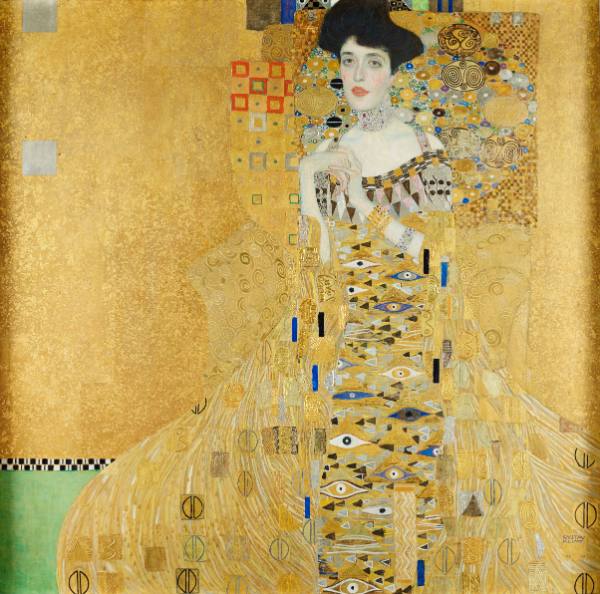
    In 1907 Gustav Klimt finished work on a portrait of Adele Bloch-Bauer (1881-1925), daughter of the banker Moriz Bauer and wife of the industrialist Ferdinand Bloch. The square-format painting has come to be viewed as one of the greatest achievements of Klimt’s “golden period” on account of the opulence of its ornamental use of gold. The turbulent history of this now world-famous portrait, a history marked by episodes of expropriation and restitution, entered a new phase in 2006, when the picture was acquired, in spectacular circumstances, by the Neue Galerie New York. No less fascinating are the studies that Klimt made in preparation for the painted portrait, most of them produced in 1903 – quite some time, that is to say, before he completed the painting itself. Of these, around 130 have so far come to light in diverse locations across the globe. While each of these exquisitely subtle works on paper is, in every sense, eclipsed by the completed painting, it is nonetheless true that, on account of the sensitivity of Klimt’s use of line, each of these drawings may truly be acclaimed as a perfectly autonomous work of art. In the presence of the sitter, Klimt as draughtsman, repeatedly set himself the challenge of capturing his model – dressed in a variety of fashionable outfits and adopting a range of elegant poses – in the totality of her appearance and yet perfectly in accord with the two-dimensional form on the sheet in front of him. In sheet after sheet it is clear that he was seeking the perfect synthesis of pose, gesture and the most fitting form of dress. Gustav Klimt was quite evidently fascinated by the very particular sensual allure of this young woman of 22; and it was in response to the inspiration he found in her that he was moved to make an unusually large number of the enchanting preparatory studies that are now regarded as among the highpoints of his work as a draughtsman. Each of the three studies discussed in the following text throws a different light on the intensity of Klimt’s approach to drawing from the model. Earlier research suggests that the drawing in which Adele Bloch-Bauer, seated in an armchair, is viewed frontally [Strobl 1066-GKZ1066] is among the earliest in the series. By means of some gentler and some more powerfully curving strokes of his chalk, Klimt uses the resulting lines to distinguish clearly between the several components within the drawing. The sitter’s lower left arm rests upon her crossed knee, marking the intersection of the plain triangle of the skirt and densely patterned area of the blouse. The bent right arm with its slightly crippled hand is no more than suggested; the contiguous, entirely vertical contour of the body is, by contrast, set off emphatically against the vacuum of the chair. An unmistakable feature of almost all Klimt’s studies of Adele Bloch-Bauer is the cropping of the face by the upper edge of the sheet – a device inspired by the work of the Belgian Symbolist Fernand Khnopff. This here has the effect of projecting forward into an illusion of proximity the triangular stylisation of the sitter’s mouth. At the same time such exercises in fragmentation – the skirt is itself partially cropped by the right edge of the sheet – effectively erect a barrier between the subject and the observer. All the drawings Klimt made in preparation for his famous portrait are characterised by this mysterious ambivalence between sensual proximity and a majestic distance. Klimt’s deep-rooted tendency to subordinate the poses and gestures of his model to a higher, geometrical order is especially evident in another study of Adele Bloch-Bauer [Strobl 1080-GKZ1080], whom he mostly showed in a seated position. As if he were employing sketchily outlined building blocks, Klimt constructs the “architecture” of the figure, who remains firmly anchored in her chair. As in many of the other drawings of this sitter, the less attentive Klimt is to delineating the eyes, the more impact is imparted to the mouth. As in every study, this characteristically triangular mouth is at first rendered delicately, and is then – with its position slightly shifted – emphatically outlined. The asymmetrical positioning of the sitter in the drawing anticipates her placing within the painting no less than does the angular rendering of the thin arms and the clasped hands. A carefully calculated overlapping of forms establishes a sense of balance imbued with a tension between spaces that are “full” and spaces that are “empty”. It is in the large group of drawings in which Adele Bloch-Bauer is shown seated, wearing a dress of delicate pleated material that falls freely from a narrow band attached to shoulder straps, that Klimt would appear to have fully attained all that he had been striving for in these studies. With the animated jutting of each line he seems to engage in a veritable tight-rope walk between sensitivity and a sublimated power, between sensuality and transcendence. The drawing presented here [GKZ3844], which is not included in Alice Strobl’s catalogue raisonné, is a great rarity in that Klimt supplements and complements the undulating lines drawn in black chalk with corresponding lines drawn in yellow. In combination with the colour of the drawing surface, this generates endless, shimmering nuances, which in turn give rise to an incomparable luminosity. This remarkable combination of black and yellow chalk has so far been discovered in only one other study from this group. As Alice Strobl conjectured, it is possible that Klimt, during this phase of his career, may already have planned to produce a “gold” painting. Klimt did indeed refer to the flowing parallel lines in his studies from the model when he came to work, with gold and silver, on his celebrated painting of Adele Bloch-Bauer. What does not recur in the painting is that blend of sensual immediacy and lyrical buoyancy that we find in the drawn studies.

    Translation: Elizabeth Clegg, London

    Bildtext
    Marian Bisanz-Prakken, 2012:

    Im zeichnerischen Œuvre Gustav Klimts nehmen die Studien für die weiblichen Porträtgemälde einen breiten Raum ein. Einen künstlerischen Höhepunkt in diesem Rahmen bilden die Studien für das Bildnis Adele Bloch–Bauer I, von denen hier ein markantes Beispiel zu sehen ist. Das 1907 voll endete Porträtbild zählt – gemeinsam mit dem 1908 geschaffenen Gemälde Der Kuß – zu den Meistwerken des „Goldenen Stils“ (Klimts berühmteste Schaffensperiode, ca. 1904– 1909).

    Adele Bauer, 1881 in Wien als Tochter des Generaldirektors des Wiener Bankvereins, Moriz Bauer, geboren, heiratete 1899 den 17 Jahre älteren Zuckerfabrikanten Ferdinand Bloch. Dieser erteilte Gustav Klimt 1903 den Auftrag, das Porträt seiner Frau zu malen, dessen Vollendung sich über vier Jahre hinziehen sollte. In den 1903–1904 entstandenen Studien posiert die modebewusste junge Frau in einer Vielzahl von Kleidern und Gewandkombinationen. Ein Großteil dieser Blätter ist von einer lyrischen Beschwingtheit und einer sinnlichen Ausstrahlung geprägt (die mehrfach angestellten Spekulationen in Bezug auf eine intime Beziehung zwischen dem Maler und seinem Modell konnten bisher nicht bestätigt werden). Die vorliegende Studie beleuchtet einen besonderen Aspekt dieser Arbeiten: Die frontale Stellung des Oberkörpers, die Geradlinigkeit der eckigen Arm– und Schulterpartie sowie der vertikal abgeschnittene Lehnstuhl weisen deutlich auf Klimts neuartige Auseinandersetzung mit den Prinzipien der Monumentalkunst hin. Zu dieser entscheidenden Wende in seiner Entwicklung hatte ein Jahr zuvor die Arbeit am Beethovenfries (1902) wesentlich beigetragen. In den Bloch–Bauer–Studien betonen die sensibel geführten Kreidelinien die Umrisse, bei einer ständigen Balance zwischen treffender Charakterisierung und strenger Flächengebundenheit. Die unverwechselbare Note dieser Zeichnungen bildet der kräftig akzentuierte, dreieckig stilisierte Mund, so auch in der hier präsentierten Arbeit. Gemeinsam mit der vom oberen Blattrand überschnittenen Stirnpartie offenbart sich in diesem Detail die für Klimt charakteristische Verbindung von sinnlicher Präsenz und geheimnisvoller Distanz. Ein auffallendes Merkmal dieser Zeichnung ist die eckige Gestaltung der schlanken, kompliziert ineinander verschränkten Hände; dieses Darstellungsprinzip sollte im ausgeführten Gemälde – bei einer geänderten Position der Arme und Hände – eine sehr markante Rolle spielen. Zweifellos entsprach die nervös–elegante, „gotische“ Gestik dem sensiblen Naturell der intellektuell orientierten Frau. Gleichzeitig aber lag dieser spezifischen Gestaltungsweise vermutlich der verkrüppelte Finger zugrunde, den die Porträtierte – einer späteren Aussage ihrer Nichte Maria Altmann zufolge (siehe den Literaturhinweis „Gustav Klimt und die Frauen“) – stets zu kaschieren versuchte. So gelangt die vielfach abgewinkelte Stellung der Hände in beiden Fällen – in der Studie wie im Gemälde – zum spannungsvollen Element der Gesamtgeometrie.


    Last edited31.12.2025

    Informationen zu diesem Werk können sich aufgrund laufender Forschungsarbeiten ändern.

    Information about this work may change as the result of ongoing research.
    ExpandView PDFPermalinkhttps://digitalepublikationen.albertina.at/en/objects/19-592995/studie-zu-bildnis-adele-blochbauer-sitzend-von-vorne