
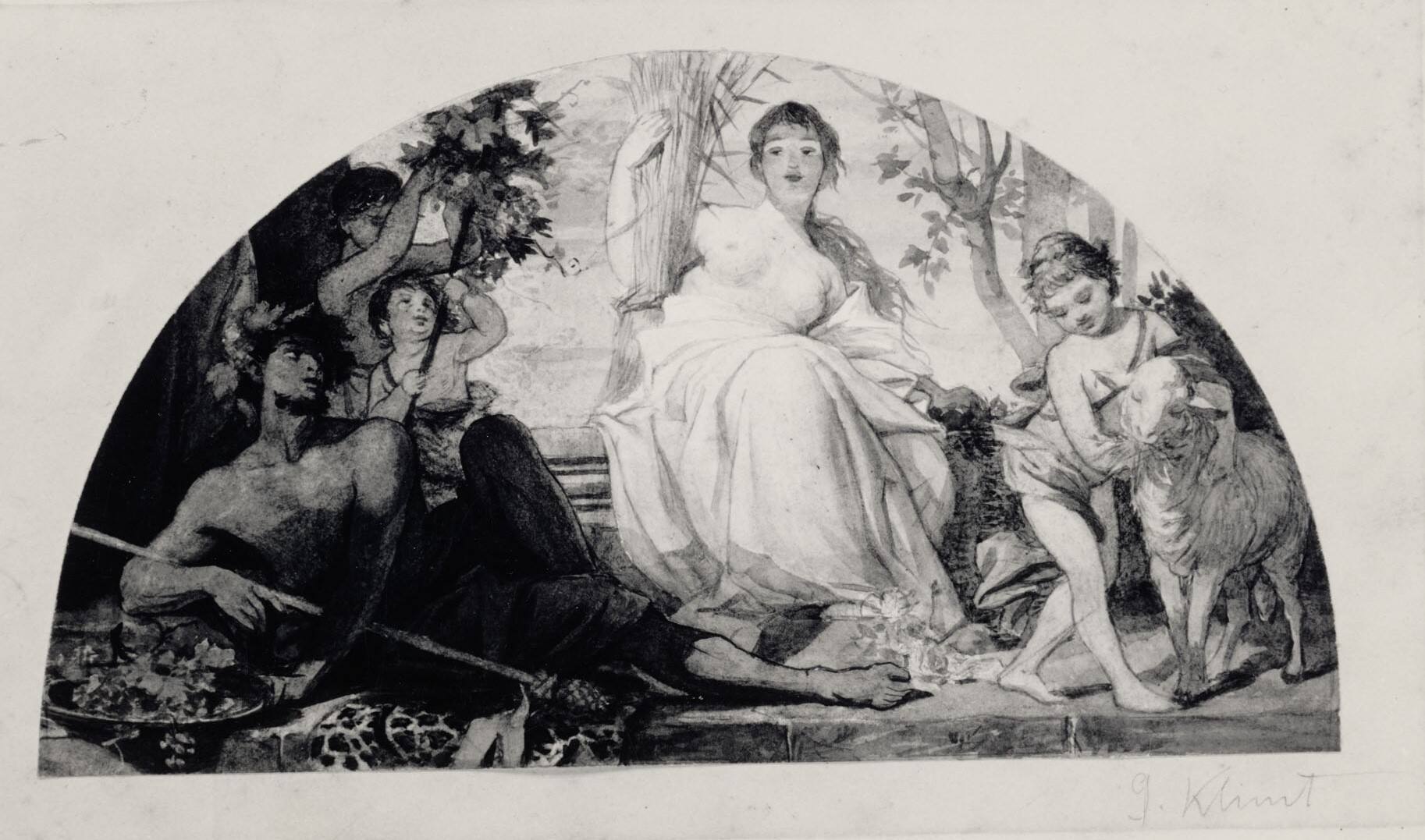
Allegorie auf die Landwirtschaft
Gustav Klimt
1880/81
Auktion29.3.1920 Kunstantiquariat und Auktionshaus S. Kende (Österreich, 1918 - 1938)ehemalige:r Besitzer:inab 1920 Privatsammlung ehemalige:r Besitzer:inbis 2014 Besitzer:in unbekannt Auktion6.11.2014 Sotheby´s New York [12784]Besitzer:in Privatsammlung , SpanienAuktion18.6.2019 Ansorena [nicht verkauft](Madrid, Spanien, founded 1845)
Werkverzeichnis
When Gustav Klimt made this watercolour, dated 1880-1881 by Alice Strobl, he was a student at the Kunstgewerbeschule in Vienna, aged eighteen or nineteen. This creation can be viewed in connection with other detailed allegorical drawings that the young artist produced for the esteemed publication Allegorien und Embleme - a highlight of central-european Historicism - edited by Martin Gerlach. In many respects, the present work foreshadows the artist’s ambitious allegory, The Realms of Nature (1882, Strobl, No. 47), a meticulous graphite drawing which also presents a symmetrical arrangement of three main figures, a broad podium and a simple outline in the form of a lunette. In both compositions, inspiration is taken from the Italian Renaissance – due to the influence of Ferdinand Laufberger, Klimt's teacher until 1881. The figure of Bacchus in the present work, for instance, refers to Michelangelo's igunudi in the Sistine Chapel and is subordinate to the central figure of Ceres. While in The Realms of Nature the male protagonist is intended as the embodiment of the highest species in nature, the element of flowering and growing is represented by his lesser companion, Flora.
Beside these observations, Allegory of Agriculture is exceptional as one of the earliest elaborate examples of Klimt's watercolor technique.
Informationen zu diesem Werk können sich aufgrund laufender Forschungsarbeiten ändern.
Information about this work may change as the result of ongoing research.