
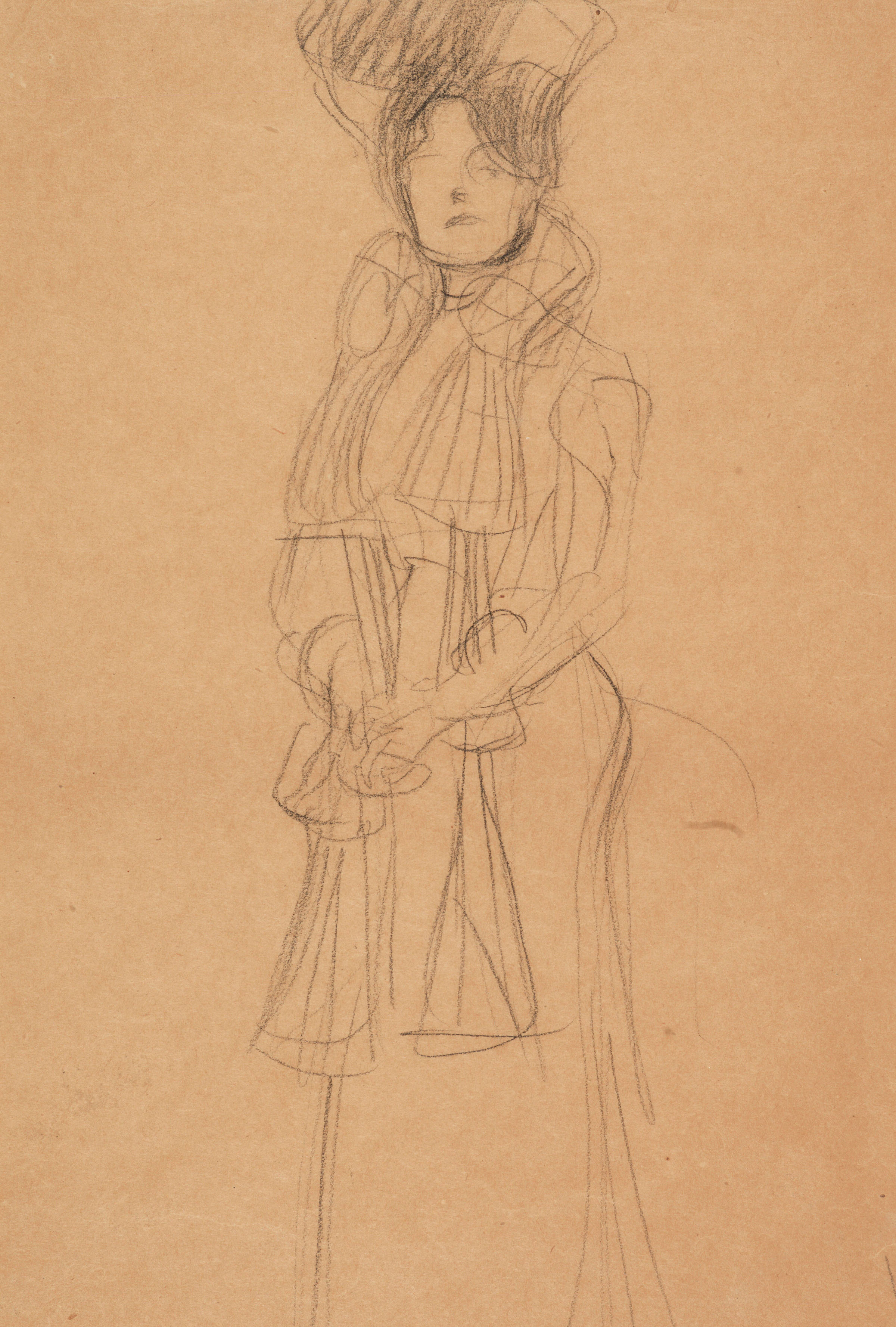
Studie zu Bildnis Marie Henneberg: Stehend von vorne, mit leichter Drehung nach links
Gustav Klimt
1901
ehemalige:r Besitzer:in Otto Brill (Pardubitz 1881 - 1954 London)Auktion31.3.1982 London, Sotheby's ehemalige:r Besitzer:in1982-2012 Besitzer:in unbekannt Auktion30.10.2012 Bonhams [22390]Besitzer:in Besitzer:in unbekannt
Werkverzeichnis
The present work is a study for Gustav Klimt's Das Bildnis Marie Henneberg, which was painted circa 1901-1902 (fig.1). Marie was the wife of Hugo Henneberg, an artist and photographer who formed the Vienna 'Trifolium', an off-shoot of the Vienna Camera Club, along with fellow photographers Hans Watzek and Heinrich Kühn. Klimt was an admirer of Henneberg's work and became acquainted with the couple through their mutual friend, the artist Carl Moll.
Henneberg had asked Josef Hoffmann and Charles Rennie Mackintosh to design him a villa, which was completed in 1902. Klimt's portrait of Marie Henneberg was positioned above a fireplace in the grand entrance hall apparently designed for this purpose: 'the portrait, which in its setting must have looked something like an altarpiece, would have been the first thing that struck visitors when they entered the house' (F. Whitford, Klimt, London, 1990, p.137).
The few surviving studies for this completed portrait show Klimt experimenting with the sitter's pose and attire. The artist apparently discarded a composition which placed her standing next to the chair and wearing a hat, as in the present work.
The finished composition is painted in a Pointillist style, with dots of paint forming a shimmering surface and creating the barest suggestion of the chair in which Marie Henneberg sits. Rather than using this technique to enhance the illusion of light and colour, Klimt used the dotted application as a decorative means of breaking up the picture plane and allowing the subject to slowly fuse with the background. In contrast, the present study is composed of quick and fluid lines. Although Henneberg's face is only sketchily suggested, our attention is drawn to it by the heavier pencil which models the sitter's upturned chin, hair and hat: 'as in all of his portraits, the focus is on the face' (A. Weidinger, Gustav Klimt, Munich, 2007, p.273). The subject's proud bearing is evident whether she is standing, hands firmly clasped together as in the present work, or seated as in the finished composition, firmly holding the viewer with her gaze.
Informationen zu diesem Werk können sich aufgrund laufender Forschungsarbeiten ändern.
Information about this work may change as the result of ongoing research.