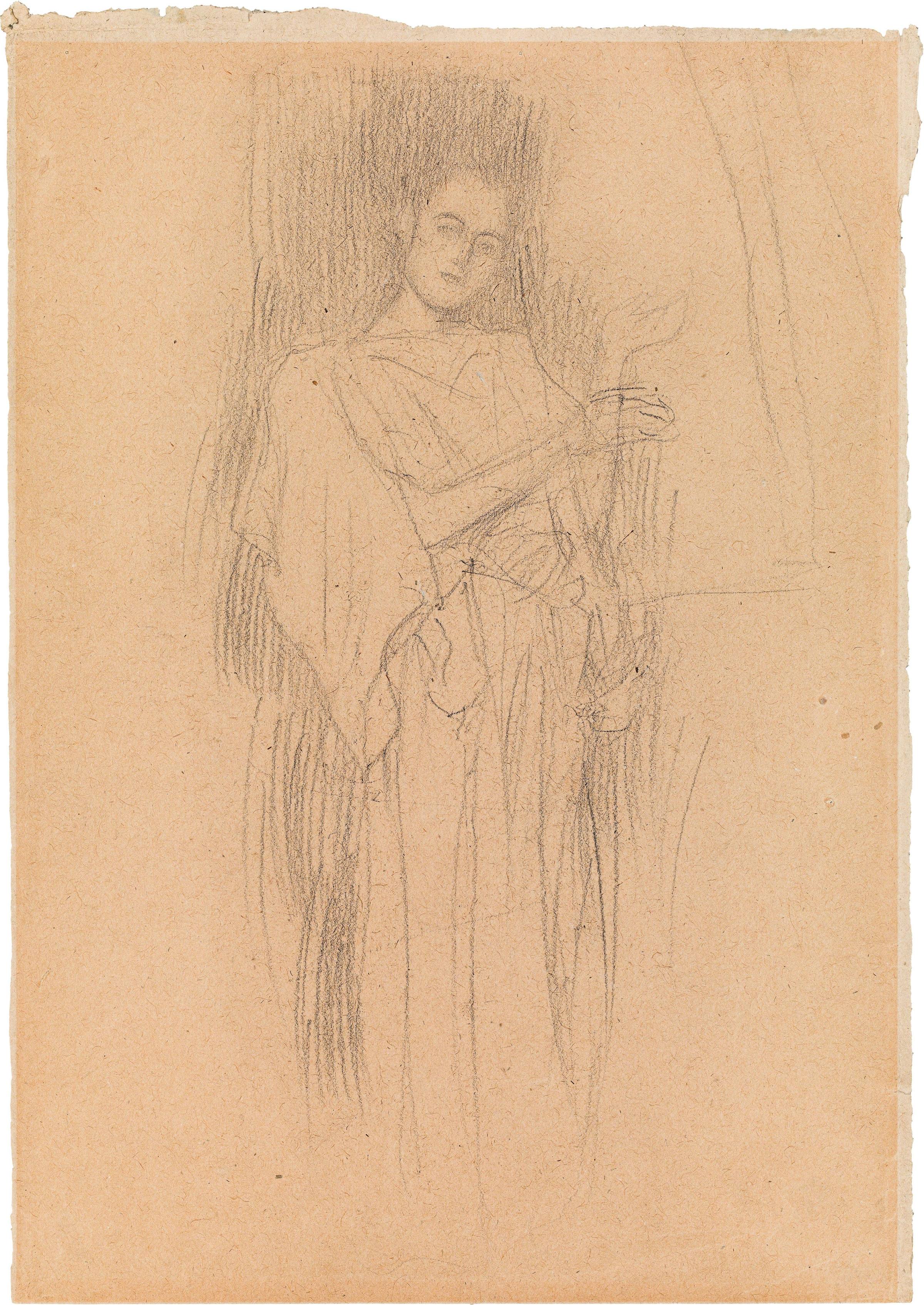
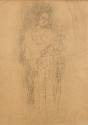
Weibliche Gestalt in langem Gewand, Studie für "Weltliche und kirchliche Musik"
Gustav Klimt
1896
- Weibliche Gestalt in langem Gewand, ein Saiteninstrument spielend
ehemalige:r Besitzer:in Hermine Klimt (Wien 1865 - 1938 Wien)ehemalige:r Besitzer:in Serge Sabarsky Gallery (New York)ehemalige:r Besitzer:in Shepherd Gallery (gegründet 1966 in New York)ehemalige:r Besitzer:in Galerie Ariadne (Wien)Auktion27.4.2012 Ketterer Kunst GmbH & Co. KG [13000](München)ehemalige:r Besitzer:in2018 Kunsthandel Wienerroither & Kohlbacher (gegründet 1993 in Wien)Auktion8.7.2021 Auktionshaus im Kinsky [32000](Wien)
Auktionskatalog
Wie Alice Strobl aufdecken konnte, entstand die zarte Studie einer musizierenden, mit langem Gewand bekleideten Gestalt im Zusammenhang mit einer 1896 entstandenen Allegorie der weltlichen und der kirchlichen Musik. Diese als Aquarell ausgeführte Arbeit befand sich in der Albertina, ging jedoch zusammen mit zwei relevanten Skizzen nach 1920 verloren; von keinem dieser Werke sind uns Abbildungen bekannt (Strobl, Bd. I, S. 92; die drei Blätter sind im Inventar der aus der Albertina ausgeschiedenen und 1920 Erzherzog Friedrich abgetretenen Werke angeführt.). Eine Reihe von kleinen Entwurfsskizzen zur Allegorie, die sich auf den Rückseiten von einigen Figurenstudien befinden, führen aber vor, welche Überlegungen Klimt zu den beiden Personifikationen angestellt hat (Ebenda, Nr. 282a -283). Die weltliche Musik tritt als antike Gewandfigur in Erscheinung und spielt ein großes Saiteninstrument; die stehende Frontalgestalt der kirchlichen Musik zeigt sich mit einem Nimbus.
In der vorliegenden Studie konzentriert Klimt sich auf die musizierenden Hände und auf das seitwärts geneigte, verträumt blickende Antlitz; das Instrument deutet er nur in den Grundzügen an. Die geheimnisvolle Art, in der die statische, ab den Knien sichtbare Figur aus dem dicht schraffierten Hintergrund auftaucht, verweist auf Klimts intensive Auseinandersetzung mit dem Symbolismus, insbesondere mit den Werken des Belgiers Fernand Khnopff. Letzterer sollte in den ersten Ausstellungen der 1897 gegründeten Secession große Erfolge feiern. Mit dem Motiv der altgriechisch inspirierten, musizierenden Gestalt hat Klimt sich bis zur berühmten „Poesie“ im „Beethovenfries" (1901/02) wiederholt befasst. Letztere spielt eine Kithara, ein großes Saiteninstrument, das Klimt auch seiner Gestalt der „weltlichen Musik“ bereits in die Hände gelegt haben mag.
Within this important group of drawings are to be found examples ranging from sheets that bear the first hints of the approaching “sacred spring” of the Viennese Secession to those that mark the end of the Utopia of an ideal merging of art and life. Like no other artist, Gustav Klimt infused Viennese Modernism with the strong sense of an ideal through his own allegorical compositions, as demonstrated by the figural studies seen here. Characteristic of Viennese Symbolism around 1896 is the mysterious radiance of the woman shown playing a hand-plucked stringed instrument [Strobl 285-GKZ285]: a study for an unrealised Allegory of Sacred and Profane Music. Deriving from the early period of the Secession – on its founding, in 1897, Gustav Klimt was elected its President – is the remarkable drawing of a nude shown floating in mid-air [Strobl 3366-GKZ3366]: a study for the figure who, in the large allegorical composition Medicine (a segment of the grand ceiling painted for Vienna University), embodies life at its most joyfully fruitful, in contrast to the great mass of “suffering” humanity. An equally positive air attends the small, naked, frontally posed figure found in Klimt’s provocative painting Pallas Athene, a study for which is shown here [GKZ3757]. This figure was in turn to serve as the starting point for the red-haired nude in Klimt’s painting of 1899, Nuda Veritas, his most programmatic affirmation of the truth of art. Similarly infused with an element of the programmatic are the blue crayon sketches for an unrealised depiction of Nike and, on the same sheet, two drawings of a frontally viewed female head [Strobl 711-GKZ711]. In contrast, the drawing of a young woman seated and bending slightly forward [Strobl 298-GKZ298] is imbued with an air of tender intimacy: it is a study for the figure at the left of the allegorical composition Music II, commissioned by Nikolaus Dumba for the music salon of his house in Vienna. Music was also one of the chief themes of Klimt’s celebrated Beethoven Frieze: an allegory of Struggle and Triumph, of Desire and Redemption, created in 1901 as a monumental form of decoration integral to the Viennese Secession’s Beethoven Exhibition of the following year. Klimt’s studies for the numerous figures featured in this work are among the pinnacles of his mastery of line. While "Lust" [Strobl 815-GKZ815] is characterised through the sensually flowing contours of her voluptuous body, the taut outlines, rigorous profile presentation and inclined head of "Poetry" [Strobl 830-GKZ830] attest spiritual concentration. Klimt’s systematic and subtly differentiating use of line is also to be found in his studies for the third of his paintings for Vienna University, Jurisprudence. Here, the figures of the Judge and of "Justice" [Strobl 3479a-GKZ3824, Strobl 3484-GKZ3484] evince a somewhat brittle linearity, while that of "Truth" [Strobl 924-GKZ924] is thrown into relief through its buoyant contours.
The paintings Hope I and Hope II address in a pessimistic spirit the mystery attending the emergence of new life; but the related studies of pregnant women evince a positive and meditative mood. In that made in preparation for Hope I [Strobl 988-GKZ988] Klimt employs a subtle linearity to emphasize the hands of the expectant mother, held protectively over her belly. The model for Hope II [GKZ3847] retains a more plainly naturalistic character. In the embracing lovers intended for a frieze commissioned for the Palais Stoclet in Brussels [Strobl 3616-GKZ3616] Klimt, for the last time, evokes the allegory of an “ideal realm” (earlier found in the Beethoven Frieze), in which man and woman are truly united in a radiant ambience. Here, at the highpoint of his “golden style”, Klimt as a draughtsman knew better than ever how to re-animate the polarity of the sexes in a manner no less sensual than spiritual.
Translation: Elizabeth Clegg, London
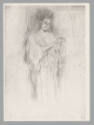
Studie für die "Weltliche Musik".
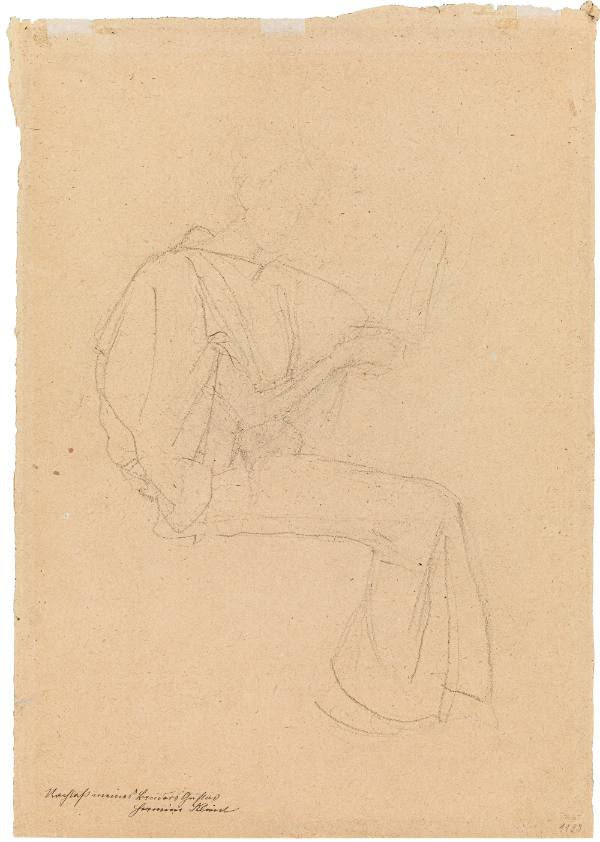
Verso: Sitzende Figur.
Informationen zu diesem Werk können sich aufgrund laufender Forschungsarbeiten ändern.
Information about this work may change as the result of ongoing research.