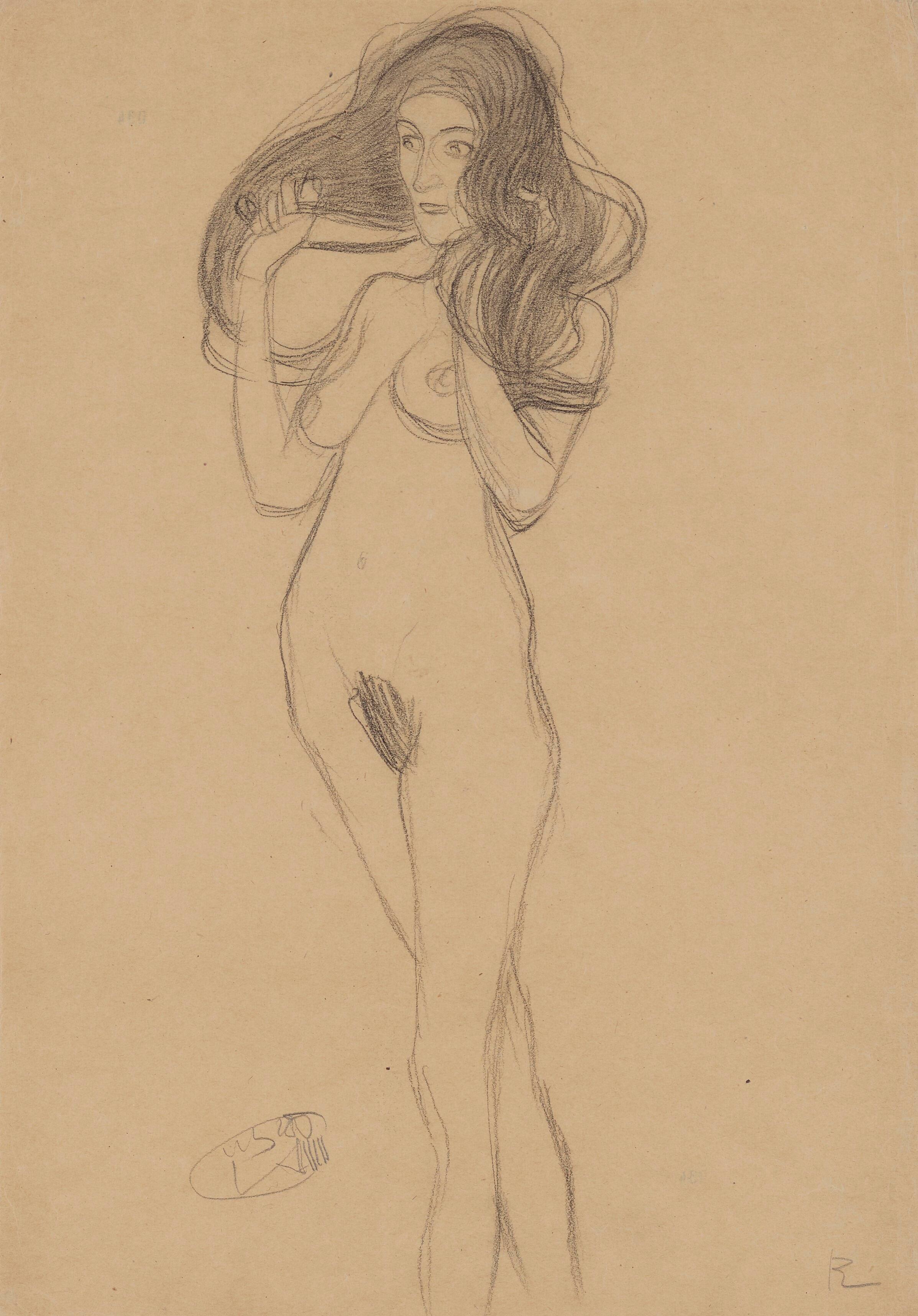
Stehender Mädchenakt nach links, die Haare mit den Händen haltend
Gustav Klimt
1901
Object numberGKZ791
Strobl-Nr.Strobl 791
Künstler:in
Gustav Klimt
(Wien 1862 - 1918 Wien)
Date1901
Dimensions45,4 × 31,5 cm
MediumSchwarze Kreide auf Papier
Signedl.u. "Gustav | Klimt" (oval)
Inscribedr.u. "R"
Besitzer:in
Privatsammlung
, USA
Curatorial RemarksBeethovenfriesExhibitionsehemalige:r Besitzer:in1903-1915 Carl Reininghaus (Graz 1857 - 1929 Wien)ehemalige:r Besitzer:in1915-1936 August Lederer (Böhmisch-Leipa 1857 - 1936 Wien)ehemalige:r Besitzer:in1936-1985 Erich Lederer (Wien 1896 - 1985 Genf)ehemalige:r Besitzer:in1985-2010 Privatbesitz , ÖsterreichAuktion13.6.2010 London, Sotheby's [108243]ehemalige:r Besitzer:in2010 Kunsthandel Wienerroither & Kohlbacher (gegründet 1993 in Wien)ehemalige:r Besitzer:inab 2010 Antal Miklos Post de Bekessy (New York 1943 - 2015 Paris)ehemalige:r Besitzer:in Besitzer:in unbekannt Auktion6.2.2014 London, Sotheby's [253385]ehemalige:r Besitzer:in2014-2019 Besitzer:in unbekannt Auktion28.2.2019 Christie's London [186517]ehemalige:r Besitzer:in2019 Kunsthandel Wienerroither & Kohlbacher (gegründet 1993 in Wien)Besitzer:inab 2019 Privatsammlung , USA
Werkverzeichnis
Alice Strobl, 1980: Siehe den Kompositionsentwurf Kat. Nr. 802, linke Skizze, die nicht ausgeführt wurde.
London, Sotheby's, 2014: Condition
Executed on cream wove paper. The work is not laid down but hinged at all four corners and at along the centre of the left and right edges and floating in the mount. The sheet is time stained. There are minor creases to the paper in places, especially along left edge and top right corner. The paper is slightly unevenly cut along lower edge. Overall good condition.
Executed on cream wove paper. The work is not laid down but hinged at all four corners and at along the centre of the left and right edges and floating in the mount. The sheet is time stained. There are minor creases to the paper in places, especially along left edge and top right corner. The paper is slightly unevenly cut along lower edge. Overall good condition.
London, Sotheby's, 2010: Condition
Executed on cream wove paper, not laid down, hinged to the mount in the top two corners, floating in the mount. Apart from some minor handling creases, mainly to the extreme edges of the sheet, this work is in good original condition.
Executed on cream wove paper, not laid down, hinged to the mount in the top two corners, floating in the mount. Apart from some minor handling creases, mainly to the extreme edges of the sheet, this work is in good original condition.
Christie's London, 2019:
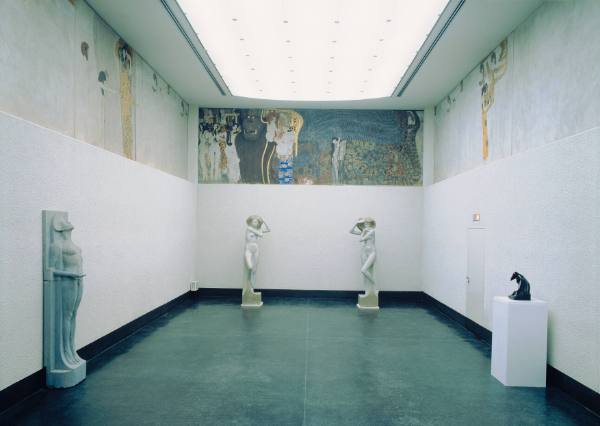
Executed in 1901, Stehender Mädchenakt nach links, die Haare mit den Händen haltend is an important preparatory drawing for Gustav Klimt’s Beethoven Frieze for the Viennese Secession building. The Beethoven Exhibition took place at the Secession between April and June 1902 and marked a crucial turning point in Klimt’s career. The artist’s preceding state commission for three paintings to decorate the Great Hall of the University of Vienna – Philosophy, Medicine and Jurisprudence – sparked outrage due to the artist’s use of nude women as a pictorial means of conveying the abstract concepts he had been asked to portray. The so-called 'Faculty Paintings', never installed in the space they were created for, would be Klimt’s last public commission, and while such a scandalous outcome was certainly disappointing, Klimt’s subsequent independence from state support allowed him to fully develop his unique style, as testified by the seminal Beethoven Frieze of 1902 that the present lot is a study for.
On the occasion of the fourteenth Secession exhibition, which was dedicated to the 75th anniversary of Ludwig van Beethoven’s death, Klimt presented his 34-metre-long Beethoven Frieze as an interpretation of Beethoven’s 9th Symphony by Richard Wagner. A total of twenty-one artists participated in the exhibition, orchestrated by Josef Hoffmann, the architect of the Secession building. A polychrome sculpture of Beethoven by Max Klinger formed the central image of the ‘Gesamtkunstwerk’, or total work of art, which emerged from the interplay of music, architecture, painting, sculpture and interior decoration, all revolving around Beethoven. With nearly 60,000 visitors, the fourteenth exhibition was one of the Secession’s greatest public successes.
Klimt’s Beethoven Frieze was conceived as a celebration of humankind’s desire for happiness in a suffering and tempestuous world in which one contends not only with external evil forces, but also with internal weaknesses. The frieze begins with a long wall of floating Genii, gliding female figures symbolising the longing for happiness, continues with a shorter end wall devoted to hostile forces, and is followed by the final wall where yearning for happiness finds appeasement in Poetry and five female figures representing the ideal realm, a place of pure joy, pure happiness, pure love. The frieze concludes with a choir of angels singing in paradise and the powerful image of a kissing couple.
The present lot depicts one of the three Gorgons that are portrayed on the left side of the frieze’s central section which captures the dark, sinister side of human existence convulsed by evil, sickness, madness, death, lust and wantonness. The Gorgons were the daughters of Typhon, the monstrous serpentine giant and most deadly creature in Greek mythology who occupies much of the central part of the frieze with his ape-like head, hairy torso, wings and snakelike body. The Gorgons had hair made of living, venomous snakes and an ability to turn those who beheld them to stone.
The Gorgon in the present work is portrayed as a sinuous, sexually provocative femme fatale with thick, untamed hair, flowing contours and a piercing look, determined and absent at once. With her entranced expression and relaxed posture, the nude woman encapsulates the allusions to sexuality and subconscious sides of the human psyche that Klimt captured like none other before him, scandalising the Viennese establishment on the one hand, and inspiring many admirers and peers on the other. Many artists were completely mesmerised by the frieze, including Auguste Rodin who, upon visiting the Secession exhibition, lauded the piece as ‘so tragic and so divine’.
Like the Beethoven Frieze itself, the present work was acquired directly from the artist by the Viennese industrialist and art collector Carl Reininghaus in 1903. Reininghaus was an ardent supporter of Vienna’s avant-garde artists including Gustav Klimt and Egon Schiele, and his ownership of the present work and other drawings by Klimt, at the time rarely seen outside the artist’s studio, would have given Schiele a unique opportunity to view the master’s work in the informal setting of the collector’s home. The Beethoven Frieze and its preparatory drawings therefore mark a radical turning point not only in Klimt’s career, but also in the development of the Viennese art scene at the turn of the century, and the generations of artists that followed. Many of the studies for the frieze now reside in museum collections, and the present work thus poses a unique opportunity to acquire a finely executed, striking drawing by the artist from one of the most momentous phases of his career.
Executed in 1901, Stehender Mädchenakt nach links, die Haare mit den Händen haltend is an important preparatory drawing for Gustav Klimt’s Beethoven Frieze for the Viennese Secession building. The Beethoven Exhibition took place at the Secession between April and June 1902 and marked a crucial turning point in Klimt’s career. The artist’s preceding state commission for three paintings to decorate the Great Hall of the University of Vienna – Philosophy, Medicine and Jurisprudence – sparked outrage due to the artist’s use of nude women as a pictorial means of conveying the abstract concepts he had been asked to portray. The so-called 'Faculty Paintings', never installed in the space they were created for, would be Klimt’s last public commission, and while such a scandalous outcome was certainly disappointing, Klimt’s subsequent independence from state support allowed him to fully develop his unique style, as testified by the seminal Beethoven Frieze of 1902 that the present lot is a study for.
On the occasion of the fourteenth Secession exhibition, which was dedicated to the 75th anniversary of Ludwig van Beethoven’s death, Klimt presented his 34-metre-long Beethoven Frieze as an interpretation of Beethoven’s 9th Symphony by Richard Wagner. A total of twenty-one artists participated in the exhibition, orchestrated by Josef Hoffmann, the architect of the Secession building. A polychrome sculpture of Beethoven by Max Klinger formed the central image of the ‘Gesamtkunstwerk’, or total work of art, which emerged from the interplay of music, architecture, painting, sculpture and interior decoration, all revolving around Beethoven. With nearly 60,000 visitors, the fourteenth exhibition was one of the Secession’s greatest public successes.
Klimt’s Beethoven Frieze was conceived as a celebration of humankind’s desire for happiness in a suffering and tempestuous world in which one contends not only with external evil forces, but also with internal weaknesses. The frieze begins with a long wall of floating Genii, gliding female figures symbolising the longing for happiness, continues with a shorter end wall devoted to hostile forces, and is followed by the final wall where yearning for happiness finds appeasement in Poetry and five female figures representing the ideal realm, a place of pure joy, pure happiness, pure love. The frieze concludes with a choir of angels singing in paradise and the powerful image of a kissing couple.
The present lot depicts one of the three Gorgons that are portrayed on the left side of the frieze’s central section which captures the dark, sinister side of human existence convulsed by evil, sickness, madness, death, lust and wantonness. The Gorgons were the daughters of Typhon, the monstrous serpentine giant and most deadly creature in Greek mythology who occupies much of the central part of the frieze with his ape-like head, hairy torso, wings and snakelike body. The Gorgons had hair made of living, venomous snakes and an ability to turn those who beheld them to stone.
The Gorgon in the present work is portrayed as a sinuous, sexually provocative femme fatale with thick, untamed hair, flowing contours and a piercing look, determined and absent at once. With her entranced expression and relaxed posture, the nude woman encapsulates the allusions to sexuality and subconscious sides of the human psyche that Klimt captured like none other before him, scandalising the Viennese establishment on the one hand, and inspiring many admirers and peers on the other. Many artists were completely mesmerised by the frieze, including Auguste Rodin who, upon visiting the Secession exhibition, lauded the piece as ‘so tragic and so divine’.
Like the Beethoven Frieze itself, the present work was acquired directly from the artist by the Viennese industrialist and art collector Carl Reininghaus in 1903. Reininghaus was an ardent supporter of Vienna’s avant-garde artists including Gustav Klimt and Egon Schiele, and his ownership of the present work and other drawings by Klimt, at the time rarely seen outside the artist’s studio, would have given Schiele a unique opportunity to view the master’s work in the informal setting of the collector’s home. The Beethoven Frieze and its preparatory drawings therefore mark a radical turning point not only in Klimt’s career, but also in the development of the Viennese art scene at the turn of the century, and the generations of artists that followed. Many of the studies for the frieze now reside in museum collections, and the present work thus poses a unique opportunity to acquire a finely executed, striking drawing by the artist from one of the most momentous phases of his career.
Last edited27.04.2026
Informationen zu diesem Werk können sich aufgrund laufender Forschungsarbeiten ändern.
Information about this work may change as the result of ongoing research.
Informationen zu diesem Werk können sich aufgrund laufender Forschungsarbeiten ändern.
Information about this work may change as the result of ongoing research.