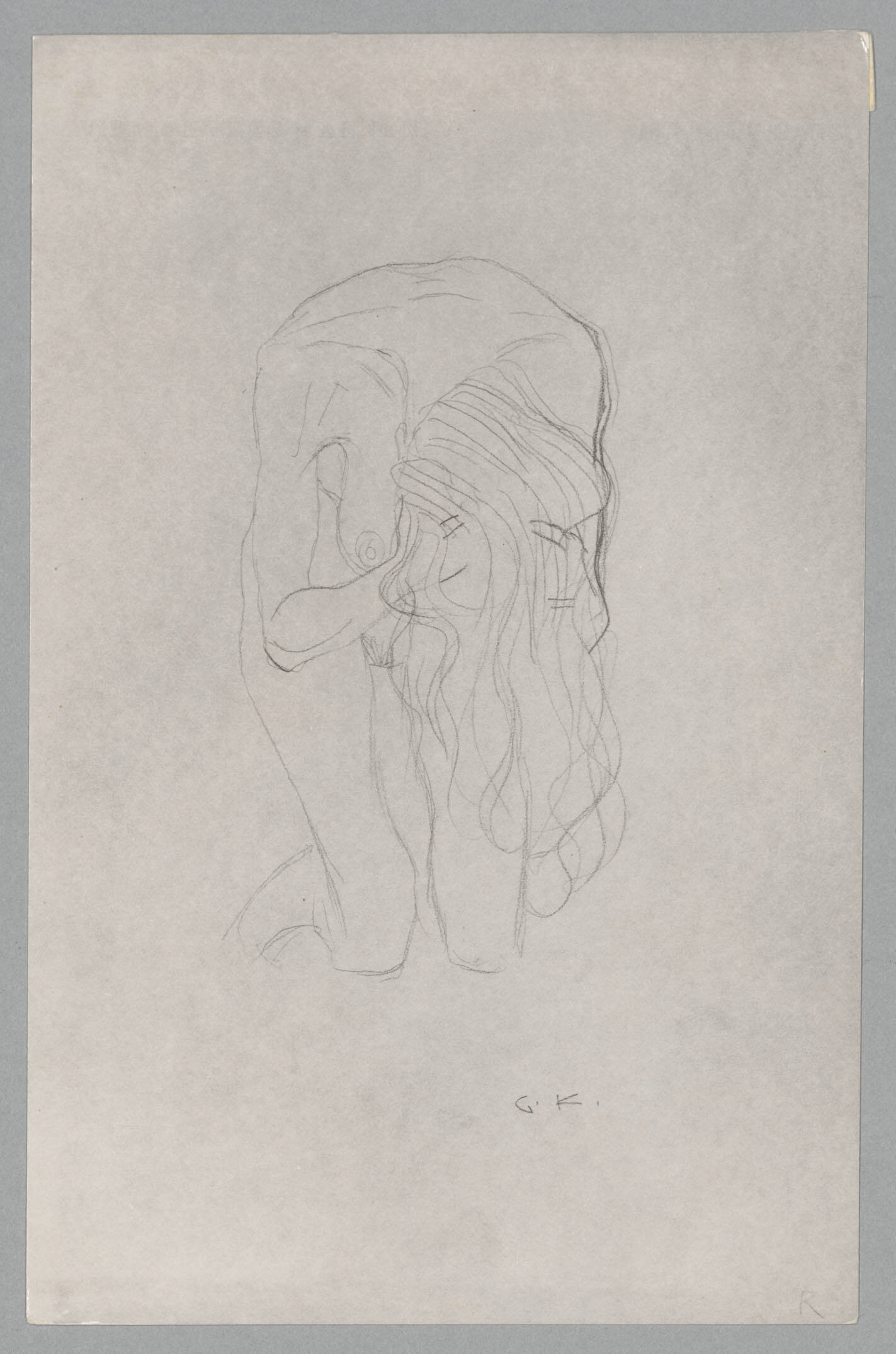
Kniender Frauenakt von vorne
Gustav Klimt
1901
ehemalige:r Besitzer:in Carl Reininghaus (Graz 1857 - 1929 Wien)ehemalige:r Besitzer:in August Lederer (Böhmisch-Leipa 1857 - 1936 Wien)ehemalige:r Besitzer:in Erich Lederer (Wien 1896 - 1985 Genf)ehemalige:r Besitzer:inab 1973 Privatsammlung Auktion16.5.1979 Sotheby Parke Bernet & Co. (New York, 1964 - 1983)ehemalige:r Besitzer:inab 1979 Privatsammlung , Londonehemalige:r Besitzer:in Privatsammlung Auktion27.8.2020 Chiswick Auctions [35762]ehemalige:r Besitzer:in2020-2023 Besitzer:in unbekannt Auktion2.3.2023 London, Sotheby's [90223]Besitzer:inab 2023 Besitzer:in unbekannt
Werkverzeichnis
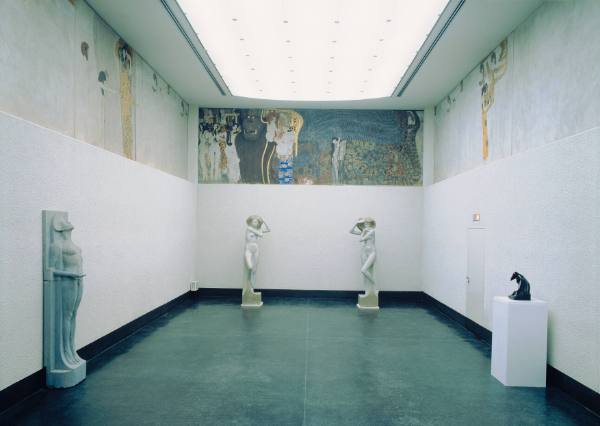
Drawn in 1901, the present work is a preparatory sketch for Gustav Klimt’s epic and monumental mural, Beethovenfries, from the following year, designed for the Vienna Secession building in conjunction with an exhibition of Max Klinger’s statue of the composer to celebrate Ludwig van Beethoven in a synthesis of art forms. The concept of the frieze was a narrative depicting man’s quest for happiness against hostile forces of sickness, madness, death and grief.
In 1903, Carl Reininghaus acquired the frieze, split into eight pieces to be removed from the walls of the Secession building, and then sold it on to August Lederer. The present work was owned by both Carl Reinighaus and August Lederer, two of Klimt’s most important supporters.
This work was thought to be a study for Nagender Kummer (Gnawing Grief) in the frieze but according to Dr Marian Bisanz-Prakken, the figure originally belonged to the first group of figures in the frieze called Die Leiden der schwachen Menschheit (The Suffering of Weak Humanity) which Klimt developed into a working sketch of a kneeling male, which he did not eventually incorporate into the final frieze.
Executed in 1901, the present work is one of the series of sketches from which Klimt worked up his epic Beethoven Frieze shown to great acclaim at the 14th Viennese Secessionist exhibition from April - June 1902. Conceived as a tribute to the composer on the 75th anniversary of his death, the exhibition was overseen by Joseph Hoffman, and featured the work of 22 different artists, including that of Max Klinger whose sculpture of Beethoven was positioned in the centre of the hall. Intended just for the duration of the show, Klimt painted his vast mural - 7 ft in height by 112 ft in length - (2 x 34 metres) directly onto the walls of the first room the public entered. Attracting nearly 60,000 visitors, the exhibition was one of the most successful mounted by the Secession, and it proved to be a turning point in Klimt's fortunes. After the show ended the mural was preserved and is now on permanent display in the basement of the Secession building in Vienna.
Klimt conceived his frieze as a celebration of mankind's search for happiness in a suffering world in which the individual is forced to contend both with the external forces of evil and personal self-doubt. Strobl catalogues the present work as being one of the studies for Nagender Kummer (Gnawing grief) in the frieze. But according to Dr Marian Bisanz-Prakken, the figure originally belonged to the first group of figures in the frieze called Die Leiden der schwachen Menschheit (The suffering of weak humanity) which Klimt developed into a working sketch of a kneeling male, but eventually chose to omit from the finished composition. For the kneeling male see: Gustav Klimt, Painting, Design and Modern Life, Exh. cat., Liverpool 2008, pp. 80-81.
Informationen zu diesem Werk können sich aufgrund laufender Forschungsarbeiten ändern.
Information about this work may change as the result of ongoing research.